LRP Calculator
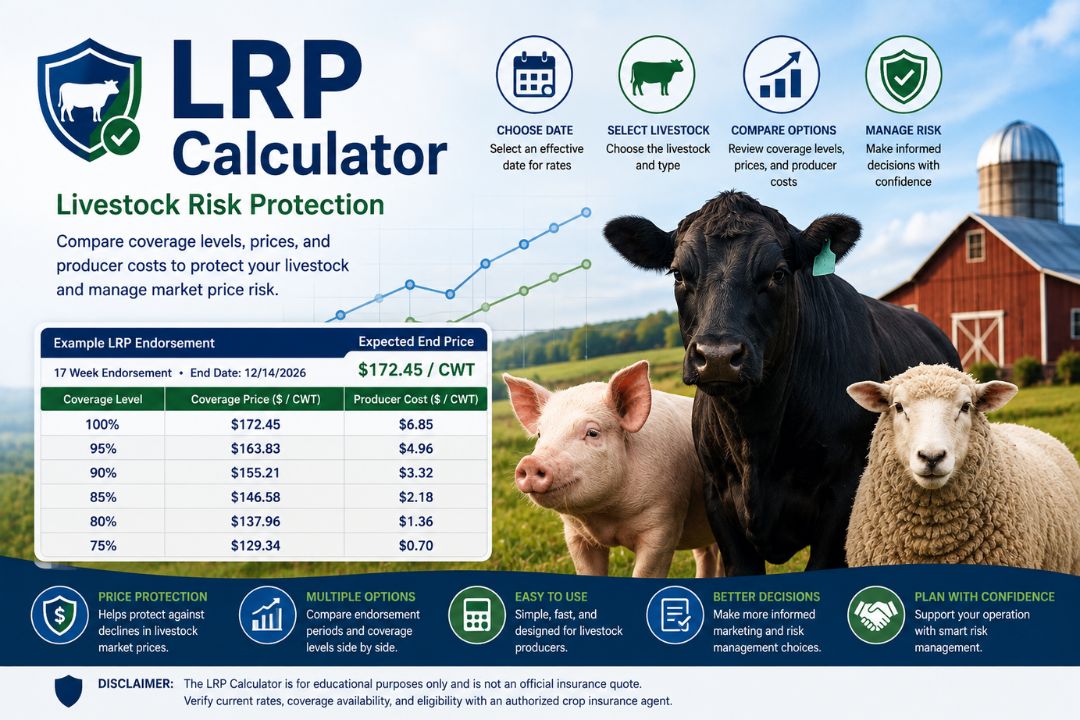
Compare Livestock Risk Protection coverage levels, coverage prices, expected ending values and producer costs by endorsement period.
LRP Prices & Rates
Select from the following options:
LRP Calculator: Understand Livestock Risk Protection Costs and Coverage
Livestock producers work in a market where prices can shift quickly. A producer may spend months raising, feeding, and preparing animals for sale, but the final market price is often uncertain until the livestock is actually marketed. This uncertainty creates financial risk because production expenses continue regardless of whether market prices rise or fall.
The CalQenix LRP Calculator is designed to make Livestock Risk Protection information easier to review. It helps users compare available LRP endorsement periods, expected ending values, coverage percentages, coverage prices, and producer costs in a simple format.
Instead of reviewing complicated insurance tables manually, users can enter or select the required information and view multiple coverage options in one place. This makes it easier to understand how different protection levels may affect the amount of price protection available and the estimated premium cost.
The calculator is useful for livestock producers, ranchers, farm managers, agricultural professionals, students, and anyone who wants to better understand how Livestock Risk Protection works.
What Does LRP Mean?
LRP stands for Livestock Risk Protection.
It is a livestock insurance program intended to help eligible producers protect themselves from unfavorable declines in market prices. Livestock producers often know approximately when their animals will be ready for market, but they do not know exactly what livestock prices will be at that future date.
A cattle producer, for example, may expect to sell livestock several months from now. Market conditions could be favorable when planning begins but significantly weaker when the animals are eventually sold.
LRP gives the producer an opportunity to establish a level of price protection for a specified period.
This does not mean LRP guarantees the exact selling price received for the livestock. Instead, the program uses defined market values and insurance calculations to determine whether a payment may be due when the insurance period ends.
The purpose is to reduce exposure to large downward movements in livestock prices.
What Is the CalQenix LRP Calculator?
The CalQenix LRP Calculator is an online tool that organizes important Livestock Risk Protection information into an easy-to-understand layout.
Users can select an effective date, livestock category, and applicable livestock type. The calculator can then display available endorsement periods and corresponding coverage information.
Depending on the available data, the results may include:
- Effective date
- Endorsement period
- End date
- Expected ending value
- Coverage percentage
- Coverage price
- Producer cost per CWT
Each piece of information helps describe a different part of the insurance option.
By displaying several coverage choices together, the calculator helps users compare possible protection levels without having to perform every calculation manually.
Why Livestock Price Risk Matters
Livestock production involves significant costs.
Expenses may include feed, veterinary services, labor, transportation, equipment, land, utilities, financing, pasture management, and other operating costs.
Many of these expenses are incurred long before livestock are sold.
That means producers frequently make production decisions today based partly on expectations about future prices.
If prices remain strong, the operation may perform close to expectations. If prices decline sharply before the planned sale date, expected revenue may fall.
This is one of the reasons price risk management is important.
A producer cannot control the entire livestock market, but tools such as LRP can help establish a degree of financial protection against certain unfavorable price movements.
The LRP Calculator makes those protection choices easier to evaluate.
How to Use the LRP Calculator
Using the calculator requires only a few steps.
First, choose the Effective Date.
The effective date is important because LRP coverage information can change over time. Prices, rates, and available options may differ from one effective date to another.
Next, select the appropriate Livestock category.
Depending on the calculator’s available data, categories may include livestock such as feeder cattle, fed cattle, or swine.
After selecting the livestock category, choose the relevant Type.
The type selection allows the calculator to display information that corresponds more closely to the selected livestock classification.
Finally, click the button to display available LRP rates and prices.
The calculator will organize the results by endorsement period so users can review the available options.
Understanding the Effective Date
The effective date tells you which day’s LRP coverage information is being reviewed.
This is important because LRP is not based on one permanent set of prices.
Market conditions change regularly, so expected values, coverage prices, and insurance rates can also change.
If you calculate an LRP option on one date and compare it with an option from another date, the numbers may not be identical.
That does not automatically mean something is wrong with the calculation.
It may simply reflect updated market conditions.
For this reason, users should always check the effective date shown in the calculator before reviewing the results.
If you are seriously considering purchasing coverage, you should verify that you are reviewing the most current information available for your situation.
What Is an LRP Endorsement Period?
An endorsement period represents the length of the insurance coverage.
Livestock is normally expected to be marketed at a particular future time, so the producer selects an insurance period that approximately corresponds with that expected sale window.
The calculator may show several endorsement periods.
For example, one livestock category may have shorter and longer insurance periods available.
Each period can have a different expected ending value because each period ends at a different point in the future.
This gives users the ability to compare protection associated with different marketing timelines.
A producer expecting to sell livestock relatively soon may review a shorter endorsement period, while a producer planning to market livestock later may look at a longer period.
The correct option depends on the individual operation and the applicable LRP rules.
What Is the End Date?
The End Date shows when the selected endorsement period concludes.
This date is important because the LRP insurance calculation is connected to values associated with the end of the coverage period.
The end date should generally be considered in relation to the producer’s anticipated livestock marketing schedule.
If animals are expected to be sold around a certain month, users can compare endorsement options whose end dates are closer to that planned marketing window.
The calculator makes this comparison easier by clearly showing the end date for each endorsement.
What Is the Expected Ending Value?
The Expected Ending Value is one of the main values used in Livestock Risk Protection.
It represents the program’s expected market value associated with the livestock at the conclusion of the selected insurance period.
It should not be interpreted as a guarantee of the actual cash market price a producer will receive.
The expected ending value primarily acts as a reference point for calculating available coverage prices.
Different endorsement periods can have different expected ending values.
For example, an endorsement ending in one month may have a different expected value from an endorsement ending several months later.
This is because market expectations can differ across future periods.
The calculator displays the expected ending value prominently so users can understand the basis of the available coverage options.
What Is a Coverage Level?
The Coverage Level represents the percentage of the expected ending value that the producer chooses to protect.
Different coverage percentages create different coverage prices.
A higher coverage level generally results in a coverage price closer to the expected ending value.
A lower coverage level provides protection at a lower threshold.
Consider a simple educational example.
Suppose the expected ending value were $200 per CWT.
At a 100% coverage level, the coverage price would be around the full expected value.
At a 95% level, the coverage price would be lower.
At a 90% level, it would be lower again.
These differences help producers decide how much price protection they want compared with the associated cost.
Understanding the Coverage Price
The Coverage Price is the insured price level associated with the chosen coverage option.
It is different from the expected ending value.
The expected ending value is the program’s projected value for the end of the insurance period, while the coverage price reflects the protection level selected by the producer.
The coverage price is important because it becomes part of the calculation used to determine whether an indemnity may be payable after the endorsement period ends.
Generally, a higher selected coverage percentage leads to a higher coverage price.
The calculator makes this relationship visible by placing the coverage level and coverage price next to one another.
This helps users quickly understand how the protection threshold changes as they move between coverage options.
What Is Producer Cost per CWT?
The calculator may also display Producer Cost per CWT.
CWT stands for hundredweight, which equals 100 pounds.
Producer cost represents the producer’s portion of the insurance premium expressed on a per-CWT basis where applicable.
This value is useful because two coverage options may offer different price protection but also have different costs.
For example, a higher coverage option may provide stronger price protection but may have a higher producer cost.
A lower coverage level may cost less while also establishing a lower coverage price.
The calculator allows these figures to be compared side by side.
This can help users think about the balance between cost and protection rather than selecting an option based only on one number.
Coverage Price and Producer Cost Are Not the Same
One common source of confusion is the difference between coverage price and producer cost.
The coverage price refers to the protected livestock price level.
The producer cost refers to the premium expense associated with that coverage.
They serve very different purposes.
For instance, you may see a coverage price of more than $100 per CWT while the producer cost is only a few dollars per CWT.
The larger number does not represent the premium.
The smaller premium number does not represent the insured livestock price.
Understanding this difference is essential when using an LRP Calculator correctly.
A Simple LRP Calculator Example
Imagine a hypothetical livestock producer reviewing an endorsement with an expected ending value of $190 per CWT.
The calculator may display several possible coverage levels.
At a higher coverage percentage, the coverage price may be close to $190.
At a slightly lower coverage percentage, the protected price would be lower.
The producer cost could also decrease as the selected coverage level decreases.
The producer can compare the available options and ask questions such as:
How much price protection do I want?
How much am I comfortable paying for that protection?
When do I expect to market the livestock?
Which endorsement period best matches the anticipated sale date?
These are the types of questions the calculator is designed to support.
The calculator does not decide which option is best. It simply presents the information in a format that makes comparison easier.
What Happens if Livestock Prices Decline?
The central purpose of LRP is protection against certain declines in livestock market values.
At the end of the insurance period, an applicable actual ending value is determined under the program.
That value is then considered in relation to the selected coverage price.
If the applicable actual ending value is below the coverage price, an indemnity may potentially be triggered depending on the policy terms and calculations.
If the actual ending value is above the selected coverage price, there generally would not be an indemnity based on price decline for that endorsement.
The actual insurance calculation may include additional factors, so users should not rely on a simplified example as a substitute for official policy information.
Does LRP Lock In My Livestock Selling Price?
No.
LRP should not be confused with directly fixing the actual cash sale price of livestock.
A producer may ultimately sell livestock for a price that differs from the values used by the insurance program.
Local market conditions, livestock quality, weight, location, buyer demand, transportation, and other factors may influence the actual sale price.
LRP is an insurance mechanism based on program-defined market values.
It is therefore more accurate to think of it as protection against certain price declines rather than a guaranteed sale contract.
Why Compare Multiple Coverage Levels?
Looking at only one coverage option provides limited information.
Comparing several levels allows users to understand how the available protection changes as the percentage changes.
A producer may find that increasing the coverage level significantly improves the coverage price but also increases the producer cost.
Another producer may decide that a lower-cost option provides sufficient protection for the operation’s financial objectives.
There is no universal coverage level that is automatically best for everyone.
Operations differ in size, cost structure, marketing strategy, debt, cash flow, risk tolerance, and expected sale timing.
The calculator’s main advantage is making these trade-offs visible.
Why Compare Different Endorsement Periods?
The future price outlook may differ depending on when livestock is expected to reach the market.
That means the expected ending value associated with one endorsement period can differ from another.
Comparing endorsement periods can be especially helpful when producers have some flexibility in their anticipated marketing schedule.
One period might offer a different expected ending value or cost structure than another.
However, users should not simply choose an endorsement because its numbers appear more attractive.
The insurance period should also make sense in relation to when the covered livestock is expected to be marketed.
Who Should Use an LRP Calculator?
An LRP Calculator can be useful for many people involved in agriculture.
Livestock producers can use it to compare potential insurance options.
Farm and ranch managers can review price protection while working on budgets and marketing plans.
Agricultural lenders may use LRP information when discussing risk management with borrowers.
Students can use the calculator to better understand agricultural insurance terminology.
Advisors and consultants may find the side-by-side results useful when explaining LRP concepts.
Even someone who has never purchased livestock insurance before can use the calculator as an introduction to the relationship between expected ending values, coverage levels, coverage prices, and producer costs.
Benefits of Using the CalQenix LRP Calculator
The CalQenix calculator is designed to make LRP information more accessible.
One major advantage is convenience.
Users can enter the required selections and review the resulting values without manually organizing multiple tables.
Another advantage is comparison.
The calculator puts coverage levels, prices, and costs together, allowing users to see differences quickly.
The tool can also reduce confusion around terminology.
Instead of looking at isolated insurance numbers, users can see how each figure fits into the overall endorsement.
The calculator may also be helpful during discussions with insurance professionals because users can become familiar with the available terminology before asking more detailed questions.
Can the Calculator Predict Future Livestock Prices?
No calculator can predict livestock markets with certainty.
The expected ending values shown through LRP are related to program methodology and market information, but future livestock prices can still change.
Unexpected supply conditions, economic changes, weather, feed markets, consumer demand, exports, processing capacity, and other events can all affect livestock markets.
The purpose of the calculator is not to forecast the market with perfect accuracy.
Its purpose is to display LRP protection information so users can make more informed risk-management comparisons.
How Often Should You Review LRP Information?
Because livestock market conditions can change, users considering LRP may want to review current information regularly.
Rates viewed several weeks ago may not reflect the values available today.
Even recent figures should be checked against the effective date.
When a producer gets closer to making an insurance decision, reviewing the latest available data becomes especially important.
Historical calculations can still be useful for comparison and education, but they should not automatically be treated as currently available insurance terms.
LRP Calculator for Cattle Producers
Cattle producers may use LRP information to evaluate potential protection against price declines before marketing eligible livestock.
Depending on current program provisions, different livestock classifications and periods may be available.
The calculator can organize those options into separate tables so users can compare coverage prices and producer costs.
This can be useful for cattle operations that want to evaluate market risk without having to interpret numerous figures manually.
LRP Calculator for Swine Producers
Swine producers also face substantial price uncertainty.
Production schedules are planned in advance, but the market price available when hogs are ready for sale can change.
An LRP Calculator allows swine producers to review endorsement periods and available levels of price protection.
Different periods may have different expected ending values, allowing producers to compare insurance information with anticipated marketing dates.
Frequently Asked Questions
Is the LRP Calculator free to use?
Yes. The CalQenix calculator can be used online as an educational tool without requiring users to manually perform the displayed calculations.
What does LRP stand for in farming?
LRP stands for Livestock Risk Protection, a form of livestock price insurance intended to help protect eligible producers from declining market prices.
What does CWT mean?
CWT means hundredweight. One hundredweight equals 100 pounds.
What is an endorsement period?
An endorsement period is the length of time associated with a specific LRP insurance endorsement.
What is the expected ending value?
It is the program’s expected value for the livestock at the end of the selected insurance period.
Is the expected ending value my guaranteed selling price?
No. Your actual livestock selling price may differ.
What is the coverage price?
The coverage price is the insured price level associated with the coverage percentage selected.
Does higher coverage always cost more?
Higher protection can generally affect premium cost, but users should rely on the actual rates shown for the applicable effective date rather than assuming a fixed relationship.
Can I purchase insurance directly from this calculator?
No. The calculator is an informational tool. Actual LRP insurance should be discussed and purchased through the appropriate authorized insurance channels.
Can LRP eliminate all livestock market risk?
No. LRP can help manage certain price risks, but livestock operations remain exposed to many other business risks and market factors.
Use the LRP Calculator as a Planning Tool
Good livestock management involves more than simply watching today’s market price.
Producers often need to think months ahead while considering production costs, marketing dates, expected revenue, and potential downside risk.
The CalQenix LRP Calculator provides a practical way to explore Livestock Risk Protection information in one organized place.
By selecting the relevant livestock category, type, and effective date, users can compare endorsement periods, expected ending values, coverage percentages, coverage prices, and producer costs.
The tool is especially useful for understanding the choices available under LRP and preparing for more detailed discussions with an insurance professional.
It should be used as a planning and educational resource rather than as a substitute for official insurance information.
Before making any insurance decision, confirm current rates, coverage availability, eligibility requirements, livestock classifications, endorsement dates, premium information, and policy conditions through official program resources and an authorized crop insurance agent.
Disclaimer: The CalQenix LRP Calculator is intended for educational and informational purposes only. Results should not be considered an official insurance offer, guaranteed premium, guaranteed indemnity, financial recommendation, or professional insurance advice. Livestock Risk Protection rules, rates, coverage options, subsidies, prices, and eligibility requirements may change. Always confirm current information with official sources and an authorized crop insurance professional before purchasing coverage or making financial decisions.
