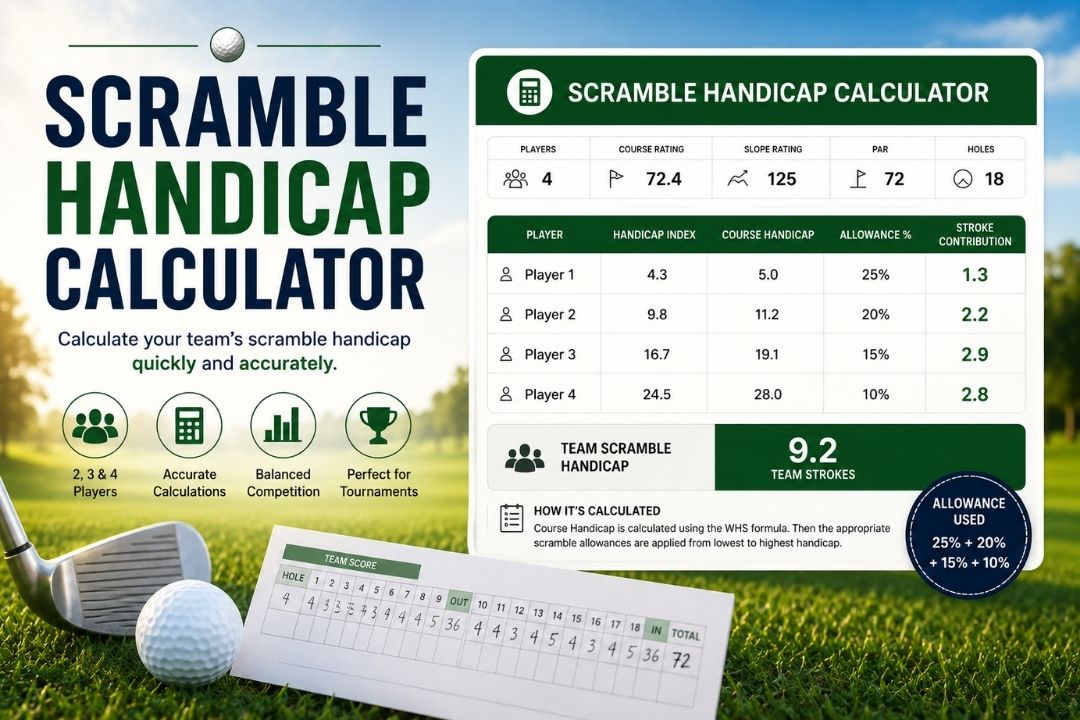
Calculate your team’s scramble handicap quickly using player handicap indexes,
slope rating, course rating, and par.
Select Team Size
Allowance used: 25% + 20% + 15% + 10%
Course Details
Player Handicap Indexes
Team Scramble Handicap
0
Allowance:
Round Type:
Player
Handicap Index
Course Handicap
Allowance
Contribution
Scramble Handicap Calculator
A Scramble Handicap Calculator is a useful golf tool that helps determine the playing handicap of a team competing in a scramble format. Scramble golf is one of the most popular team formats used in charity tournaments, corporate golf days, club competitions, social events, and friendly rounds. Since several golfers contribute to a single team score, calculating a fair team handicap is different from calculating an individual golfer’s handicap.
The CalQenix Scramble Handicap Calculator simplifies this process by using each player’s Handicap Index together with Course Rating, Slope Rating, and Par. It converts the Handicap Index of each golfer into a Course Handicap and then applies the appropriate scramble handicap allowance based on the number of players in the team.
The calculator supports common two-player, three-player, and four-player scramble formats. It automatically determines which golfer has the lowest Course Handicap, applies the correct percentage to each player, combines the handicap contributions, and calculates the team’s final Playing Handicap.
This makes it easier for golfers and tournament organizers to calculate scramble handicaps without manually working through several formulas.
What Is a Golf Scramble?
A golf scramble is a team competition in which every player hits a shot from the same position. After all players have taken their shots, the team chooses the best result. Every golfer then plays the next shot from that selected location.
The same process continues until the ball is holed.
For example, suppose four golfers are playing a scramble and all four hit their tee shots. One drive lands in the rough, another stops in a bunker, one finishes in the fairway, and the fourth travels farther down the fairway. The team may decide to use the fourth player’s drive. All four golfers then play their second shots from that location.
This format allows every golfer to contribute while reducing the pressure on less experienced players. A poor individual shot usually does not hurt the team because another player may produce a better result.
Scrambles are therefore particularly popular for mixed-skill competitions and recreational golf events.
Why Is a Scramble Handicap Needed?
A scramble team can contain golfers with very different levels of ability. One golfer may have a Handicap Index close to scratch while another may have a much higher Handicap Index.
Without a handicap system, teams containing several low-handicap players could have a major advantage over teams made up of recreational or higher-handicap golfers.
However, simply adding everyone’s full handicap would not produce a fair result either. Scramble teams repeatedly choose their best shot, meaning they have a scoring advantage that individual golfers do not have.
A team handicap therefore uses only a percentage of each player’s Course Handicap.
The strongest golfers generally receive a larger percentage because their shots are more likely to contribute to the team’s score throughout the round.
How to Use the Scramble Handicap Calculator
The calculator is designed to make scramble handicap calculations quick and simple.
First, select the number of golfers on your team. You can choose between two-player, three-player, and four-player scramble formats.
Next, enter the Course Rating, Slope Rating, and Par for the tees being played.
After entering the course information, provide the Handicap Index for every player on the team. The calculator then performs the necessary Course Handicap calculations automatically.
Once all required values have been entered, click the calculate button to see the team scramble handicap.
Select the Team Size
The first step is selecting the number of players.
Different team sizes use different handicap allowances, so this selection directly affects the result.
A two-player team commonly uses a 35% and 15% structure. A three-player scramble may use 30%, 20%, and 10%. A four-player scramble commonly uses 25%, 20%, 15%, and 10%.
The percentages are assigned according to the players’ Course Handicaps, starting with the lowest.
Enter the Course Rating
Course Rating is an important part of the World Handicap System.
It represents the expected score of a scratch golfer playing a specific set of tees under normal conditions.
Course Rating is not always the same as Par.
For example, a par-72 course could have a Course Rating of 70.8, 71.6, 73.2, or another value depending on the difficulty and length of the course.
Make sure you use the rating that corresponds to the exact tees being played.
Enter the Slope Rating
Slope Rating measures how difficult a golf course is for a bogey golfer compared with a scratch golfer.
The standard reference Slope Rating is 113.
A course with a higher Slope Rating becomes relatively more difficult for higher-handicap golfers, while a lower Slope Rating indicates a smaller difference in difficulty.
Most golf scorecards display the Slope Rating for each tee.
Enter the Course Par
Par represents the expected number of strokes required for a skilled golfer to complete the course.
Common 18-hole course par values include 70, 71, and 72, although other totals are possible.
Par is used together with Course Rating when calculating Course Handicap.
Enter Each Player’s Handicap Index
Enter the current Handicap Index for every golfer on the team.
The Handicap Index is a standardized measure of a golfer’s demonstrated playing ability. It is designed to travel with the golfer from one course to another.
The calculator converts this Handicap Index into a Course Handicap based on the difficulty of the selected golf course.
If a golfer has a plus handicap, it can be entered using a negative number for calculation purposes.
For example, a golfer with a +2.0 Handicap Index may be entered as -2.0.
What Is the Course Handicap Formula?
The Course Handicap calculation adjusts a golfer’s Handicap Index according to the difficulty of a particular course and set of tees.
The commonly used calculation is:
Course Handicap = Handicap Index × (Slope Rating ÷ 113) + (Course Rating − Par)
The calculator performs this formula automatically for every member of the scramble team.
Suppose a golfer has a Handicap Index of 12.0 and is playing tees with a Slope Rating of 125, a Course Rating of 71.4, and a Par of 72.
The calculator first multiplies the Handicap Index by the Slope Rating divided by 113. It then adjusts the result using the difference between Course Rating and Par.
The resulting value becomes the golfer’s Course Handicap for that set of tees.
Handicap Index vs Course Handicap
Handicap Index and Course Handicap are often confused, but they represent different things.
Handicap Index measures a golfer’s overall demonstrated ability.
Course Handicap adjusts that ability according to the golf course being played.
For example, a golfer may have a Handicap Index of 15.0. On an easier course, that golfer may receive a lower Course Handicap. On a difficult course with a high Slope Rating, the same golfer may receive a higher Course Handicap.
This is why scramble calculations should not always be based directly on Handicap Index alone.
The Course Handicap reflects the actual difficulty of the course and makes the scramble calculation more meaningful.
Course Handicap vs Playing Handicap
Course Handicap represents the number of handicap strokes associated with a particular course and tee.
Playing Handicap is the number of strokes actually used for a particular competition format after any handicap allowance has been applied.
In a scramble, each golfer’s Course Handicap is calculated first.
The appropriate scramble percentage is then applied to each Course Handicap.
The resulting contributions are combined to determine the team’s Playing Handicap.
Two-Player Scramble Handicap Formula
A two-player scramble typically places greater importance on each individual golfer because only two players are available to contribute shots.
A commonly used allowance is 35% of the lower Course Handicap plus 15% of the higher Course Handicap.
Suppose two golfers have Course Handicaps of 8 and 20.
The first player’s contribution would be based on 35% of 8, while the second player’s contribution would be based on 15% of 20.
These two values are then added together to create the team handicap before final rounding.
The calculator performs this automatically after determining which player has the lower Course Handicap.
Three-Player Scramble Handicap Formula
For a three-player scramble, a commonly used handicap allowance is 30% of the lowest Course Handicap, 20% of the second-lowest, and 10% of the highest.
For example, imagine that three golfers have Course Handicaps of 7, 15, and 24.
The player with a Course Handicap of 7 receives the 30% weighting. The golfer with 15 receives the 20% weighting, and the golfer with 24 receives the 10% weighting.
The calculator multiplies each Course Handicap by the corresponding percentage and then adds the values together.
Four-Player Scramble Handicap Formula
Four-player scrambles are among the most common formats used for charity tournaments and corporate golf events.
A frequently used allowance is 25% of the lowest Course Handicap, 20% of the second-lowest, 15% of the third-lowest, and 10% of the highest.
Imagine a team with Course Handicaps of 5, 11, 18, and 27.
The lowest-handicap golfer receives the 25% weighting.
The second player receives 20%, the third receives 15%, and the highest-handicap golfer receives 10%.
The four contributions are then added together to calculate the team’s Playing Handicap.
Why Are Players Sorted by Handicap?
The order in which players are entered into the calculator does not determine the percentage they receive.
The percentages are based on Course Handicap ranking.
The golfer with the lowest Course Handicap receives the first percentage. The golfer with the next-lowest handicap receives the second percentage, and so on.
This is important because entering Player 1 first does not automatically mean that Player 1 should receive the largest allowance.
The calculator sorts all golfers automatically before applying the percentages.
This eliminates one of the most common mistakes made when calculating scramble handicaps manually.
Example of a Four-Player Scramble Calculation
Consider a team with Course Handicaps of 4, 10, 17, and 25.
Using a 25%, 20%, 15%, and 10% allowance structure, each golfer makes a different contribution to the team handicap.
Twenty-five percent of the lowest Course Handicap is calculated first.
Twenty percent of the second-lowest handicap is then added.
Fifteen percent of the third handicap is included, followed by 10% of the highest handicap.
The combined value becomes the team’s scramble handicap before the final rounding procedure is applied.
This method reflects the fact that stronger golfers usually have a larger influence on a scramble team’s scoring.
Why Scramble Handicap Percentages Are Different
Scramble allowances are weighted because players do not contribute equally during most rounds.
A low-handicap golfer is more likely to produce the team’s best drive, approach shot, bunker shot, or putt.
Higher-handicap golfers can still make important contributions, but those contributions may occur less frequently.
Using different percentages attempts to account for this difference.
If every golfer received the same percentage, some team combinations could gain an unintended advantage.
Weighted allowances help make scramble competitions more balanced.
Can You Use the Calculator for a 9-Hole Scramble?
Yes. The CalQenix Scramble Handicap Calculator includes support for 9-hole and 18-hole rounds.
Nine-hole scrambles are popular for evening leagues, short club competitions, workplace events, and quick social rounds.
When using the calculator for nine holes, make sure the course information corresponds to the same nine-hole section being played.
The Course Rating, Slope Rating, and Par should all represent the same tee and hole configuration.
Using a nine-hole Par with an 18-hole Course Rating could produce an inaccurate result.
What Is a Plus Handicap Golfer?
A plus-handicap golfer is a player whose demonstrated ability is better than that of a scratch golfer.
Instead of receiving strokes, a plus-handicap golfer may effectively give strokes back depending on the competition format.
For calculation purposes, many online calculators represent a plus Handicap Index using a negative value.
For example, a +3.0 golfer may be entered as -3.0.
The calculator can process these values as part of the team handicap calculation.
Gross Score vs Net Score in Scramble Golf
Gross score is the actual number of strokes taken by the team during the round.
Net score is the score after the applicable handicap adjustment has been applied.
Suppose a scramble team records a gross score of 67 and receives a Playing Handicap of 6.
Depending on the tournament’s scoring procedure, the team’s handicap-adjusted result may be 61.
The net scores of all teams can then be compared to determine the final standings in a handicapped scramble competition.
Why Use a Scramble Handicap Calculator?
A calculator saves time and reduces errors.
Calculating Course Handicap for several players manually can already take time. After that, the golfers must be ranked correctly, percentage allowances must be applied, and all contributions must be combined.
Tournament organizers dealing with many teams may need to repeat this process dozens of times.
The Scramble Handicap Calculator handles the calculations in seconds.
It can also show the individual Course Handicap, allowance percentage, and handicap contribution for each golfer.
This makes the final result easier to understand and verify.
Common Scramble Handicap Calculation Mistakes
One common mistake is applying the scramble percentage directly to the player’s Handicap Index instead of first converting it into Course Handicap.
Another mistake is using the wrong Slope Rating or Course Rating.
Each tee box may have its own rating, so golfers should make sure they are entering the information for the tees actually being played.
Players may also apply the allowance percentages in the wrong order.
The highest percentage normally goes to the golfer with the lowest Course Handicap, not necessarily the first player entered.
Rounding intermediate values too early can also cause small differences in the final result.
Using an online calculator helps avoid many of these problems.
Where Can You Find Course Rating and Slope Rating?
Course Rating and Slope Rating are usually displayed on the golf course scorecard.
They may also be available on the golf club’s website, handicap system, national golf association database, or course information page.
Different tees usually have different ratings.
For example, championship tees may have a higher Course Rating and Slope Rating than forward tees because they are longer and more difficult.
Always check the correct tee before entering the information into the calculator.
What If Players Use Different Tees?
Some scramble competitions allow golfers to play from different tee sets.
This is common in mixed competitions, junior events, senior tournaments, or events where different categories of golfers play from different tees.
When players use different tees, additional adjustments may be required depending on the competition rules.
In these situations, golfers should follow the instructions provided by the tournament committee.
The organizer’s published competition rules should always take priority over a general calculator.
Do All Scramble Tournaments Use the Same Handicap Formula?
No.
Many events use commonly recommended scramble allowances, but tournament organizers can establish their own rules.
Some competitions may use alternative percentage allowances.
Others may impose a maximum team handicap, cap individual Handicap Index values, require a minimum number of drives from each player, or use a completely different handicap calculation.
Before using a calculated handicap in an official tournament, check the event’s Terms of Competition.
If the organizer specifies a different method, the tournament’s rules should be followed.
Scramble vs Best Ball
Scramble and best ball are both team formats, but they work differently.
In a scramble, all golfers play from the location of the team’s selected best shot after every stroke.
In best ball, each golfer plays their own ball from tee to hole.
The team score for the hole is then based on the best individual score among the team members.
Because the formats are different, their handicap calculations are also different.
A scramble handicap calculator should therefore not be used as a substitute for a best-ball handicap calculator.
Scramble vs Stroke Play
Traditional stroke play requires each golfer to complete every hole using their own ball.
Every stroke counts toward the player’s final score.
In a scramble, several golfers cooperate to produce one team score.
This gives the team multiple opportunities to produce a good shot from each position.
That advantage is one of the main reasons scramble competitions require special handicap allowances.
Who Should Use This Calculator?
The Scramble Handicap Calculator is useful for individual golfers, golf societies, club administrators, charity tournament organizers, corporate event planners, league managers, and recreational golf groups.
Golfers can use it before a competition to estimate their team’s handicap.
Tournament organizers can use it to quickly check team entries.
Golf societies can use it when creating balanced competitions among players of different skill levels.
The calculator is also useful for golfers who simply want to understand how scramble handicap calculations work.
Frequently Asked Questions About Scramble Handicaps
How Do I Calculate a Scramble Handicap?
Convert each player’s Handicap Index into a Course Handicap using the course rating information, rank the golfers from lowest Course Handicap to highest, apply the appropriate scramble percentages, add the contributions together, and round the final result according to the competition procedure.
The calculator completes these steps automatically.
What Is the Handicap Allowance for a Four-Person Scramble?
A commonly used allowance is 25% of the lowest Course Handicap, 20% of the second-lowest, 15% of the third-lowest, and 10% of the highest.
Individual tournaments may use different allowances, so always check the competition rules.
What Is the Handicap Allowance for a Two-Person Scramble?
A commonly used approach is 35% of the lower Course Handicap plus 15% of the higher Course Handicap.
What Is the Handicap Allowance for a Three-Person Scramble?
A commonly used structure is 30% of the lowest Course Handicap, 20% of the second-lowest, and 10% of the highest.
Do I Enter Handicap Index or Course Handicap?
The CalQenix calculator asks for Handicap Index and calculates Course Handicap automatically using Course Rating, Slope Rating, and Par.
Does the Lowest Handicap Golfer Get the Highest Percentage?
Yes. Under the common allowance structures used by this calculator, the golfer with the lowest Course Handicap receives the highest weighting.
Can a Scramble Team Have a Plus Handicap?
Yes. A team containing very strong golfers, particularly scratch or plus-handicap players, may potentially produce a plus Playing Handicap.
Can Beginners Play in a Scramble?
Yes. Scramble golf is one of the most beginner-friendly competition formats because golfers do not have to use every shot they hit.
A beginner can contribute a good drive, approach shot, or putt while relying on teammates when other shots are less successful.
Can I Use This Calculator for a Charity Tournament?
Yes. Scrambles are extremely common in charity golf events. However, organizers should specify the handicap allowances used by the tournament so every team is calculated consistently.
Should I Round Each Player’s Course Handicap First?
For calculations that require unrounded Course Handicap values before applying allowances, rounding too early may slightly alter the final result.
The calculator performs the intermediate calculation automatically before producing the final team Playing Handicap.
Benefits of Using the CalQenix Scramble Handicap Calculator
The CalQenix Scramble Handicap Calculator offers a quick way to convert player Handicap Indexes into a practical team scramble handicap.
There is no need to manually calculate Slope adjustments, Course Rating differences, ranking positions, allowance percentages, and total contributions.
The calculator also provides a transparent breakdown of the result.
Users can see each player’s Handicap Index, calculated Course Handicap, allowance percentage, and individual contribution to the final team handicap.
This is particularly useful when golfers want to verify how their team result was calculated.
Final Thoughts
A Scramble Handicap Calculator makes one of the more complicated parts of team golf much easier.
Scramble competitions involve multiple players contributing to a single score, which means individual handicaps cannot simply be added together.
By converting each golfer’s Handicap Index into a Course Handicap and then applying weighted scramble allowances, the calculator produces a team Playing Handicap that better reflects the composition of the team and the difficulty of the golf course.
Whether you are preparing for a two-player scramble, three-player event, four-person charity tournament, corporate golf day, club competition, or friendly weekend round, the CalQenix Scramble Handicap Calculator provides a fast and convenient way to estimate your team’s handicap.
Enter the course details, choose the number of players, add each golfer’s Handicap Index, and calculate your team handicap before heading to the first tee.