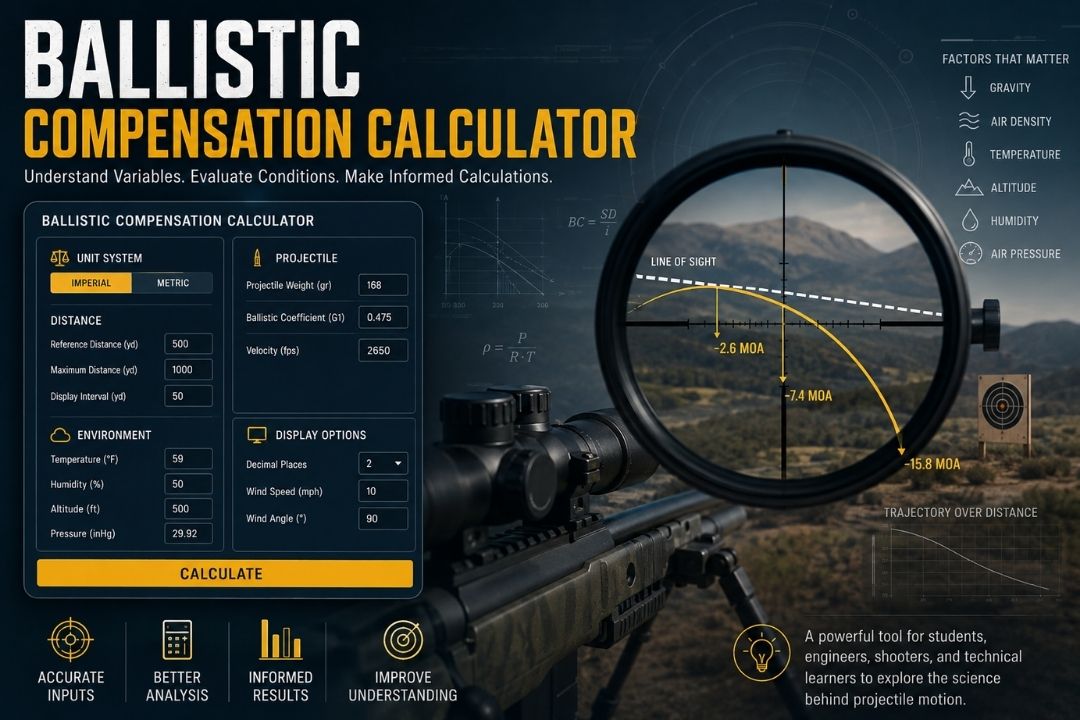
Organize projectile characteristics, distance,
environmental conditions and measurement preferences
in one easy-to-use calculator interface.
Ballistic Calculator
Enter the information below to configure your calculation.
i
This calculator interface is intended for educational
and informational purposes and does not generate firearm
aiming, scope adjustment or firing solutions.
1
Measurement Settings
2
Projectile Information
gr
ft/s
3
Distance Information
yd
yd
yd
4
Environmental Conditions
°F
%
ft
inHg
5
Display Preferences
Please enter valid values before continuing.
Calculation Summary
Review the data entered into the calculator.
Measurement System
Imperial
Reference Distance
—
Projectile Weight
—
Temperature
—
Altitude
—
Humidity
—
What Is a Ballistic Compensation Calculator?
A ballistic compensation calculator is an online tool
designed to organize variables that can influence the
motion of a projectile through the atmosphere. These
variables can include distance, projectile characteristics,
environmental temperature, atmospheric pressure, altitude,
humidity and aerodynamic reference information.
Projectile motion becomes increasingly complex when
aerodynamic resistance and changing environmental
conditions are considered. A structured calculator
provides a convenient way to review these factors in
one place.
How to Use the Ballistic Calculator
Start by selecting your preferred measurement system.
Calqenix supports both Imperial and Metric units, allowing
the interface to automatically update relevant unit labels.
Next, enter the available projectile characteristics,
distance information and environmental conditions.
Carefully review each measurement before continuing,
especially when values come from multiple sources that
may use different unit systems.
Projectile Information
Projectile mass and aerodynamic reference values are
commonly used when studying projectile motion. Different
projectile shapes and masses can interact with the
atmosphere in different ways.
Environmental Conditions
Temperature, atmospheric pressure, altitude and humidity
can influence atmospheric density. Because these conditions
change with location, weather and time, environmental data
should be treated as specific to the conditions in which it
was measured.
Understanding Ballistic Coefficient
Ballistic coefficient is a reference value used to
describe aerodynamic characteristics relative to a
particular drag model. Different reference models may
be used for different projectile geometries.
When comparing coefficient values, users should confirm
that the values were produced using compatible reference
models. A number associated with one drag model should
not automatically be interpreted as equivalent to a
number associated with another model.
Imperial and Metric Measurements
Technical information can be expressed using either
Imperial or Metric units. Distance may be represented
in yards or meters, mass may be presented in grains
or grams, and atmospheric values can also use different
conventions.
Maintaining a consistent measurement system helps reduce
conversion errors and makes technical information easier
to compare.
Important Calculator Limitations
Mathematical models simplify real-world behavior. Actual
projectile motion may be affected by additional variables,
measurement uncertainty, manufacturing differences and
changing environmental conditions.
Information generated or organized by an online calculator
should therefore be treated as educational reference
information rather than a guaranteed real-world outcome.
Ballistic Compensation Calculator
A Ballistic Compensation Calculator is an educational tool designed to help users understand how different physical and environmental variables can influence the movement of a projectile through the air. Instead of studying each factor separately, this type of calculator brings important values together in one structured interface so users can review how distance, projectile characteristics, atmospheric conditions, and measurement systems relate to one another.
The Ballistic Compensation Calculator on Calqenix is designed to simplify a technical subject by presenting the most relevant inputs in a clear and organized format. Users can enter projectile information, environmental conditions, reference distances, and measurement preferences while switching between Imperial and Metric units.
Ballistic calculations can become complex because a projectile does not travel through a perfectly controlled environment. Gravity, aerodynamic resistance, air density, temperature, humidity, altitude, and other variables may all influence motion. A calculator helps users organize these inputs in a logical way and better understand their relationships.
The Calqenix calculator should be treated as an informational and educational tool. Real-world behavior can differ from theoretical or calculated results because mathematical models simplify complex physical conditions.
What Is Ballistic Compensation?
Ballistic compensation refers broadly to accounting for changes that occur while a projectile travels through the atmosphere. Once a projectile begins moving, it is affected by several forces and environmental conditions.
Gravity continuously acts on the projectile. Air resistance slows its movement. Atmospheric density influences drag. Temperature, altitude, and humidity can change the characteristics of the air through which the projectile travels.
As distance increases, the influence of these factors can become more noticeable. This is why ballistic analysis usually involves more than a single measurement.
A compensation calculator provides a convenient way to organize relevant data so users can understand the different variables involved in projectile motion.
How the Ballistic Compensation Calculator Works
The Calqenix Ballistic Compensation Calculator uses a structured set of fields that represent common projectile and environmental variables.
Users begin by selecting a preferred measurement system. They can then enter projectile characteristics, distance information, and atmospheric conditions. The interface groups related values together so the calculator is easy to navigate.
The tool supports both Imperial and Metric units, allowing users from different regions to work with measurements that are familiar to them.
Once data has been entered, the calculator interface can organize the information into a summary. This makes it easier to review inputs and identify potential mistakes such as incorrect units or missing values.
Selecting the Measurement System
The first step is choosing either Imperial or Metric measurements.
Imperial measurements commonly use yards for distance, feet for altitude, grains for projectile weight, feet per second for velocity references, and degrees Fahrenheit for temperature.
Metric measurements commonly use meters for distance, grams for mass, meters per second for velocity references, and degrees Celsius for temperature.
Selecting the correct system at the beginning helps prevent unit conversion errors.
Why Measurement Consistency Matters
Technical calculations depend heavily on consistent units.
If one value is entered in meters while another is assumed to be yards, the resulting interpretation can become inaccurate. Similar problems can occur when mass values are confused between grams and grains or temperatures between Celsius and Fahrenheit.
The Calqenix calculator reduces this problem by changing unit labels when the measurement system is switched.
Users should still verify each input before continuing. Automated unit displays are helpful, but careful data entry remains important.
Understanding Reference Distance
Distance is one of the most important variables in projectile motion.
A projectile traveling a short distance experiences gravity and drag for less time than one traveling a longer distance. As travel time increases, the effects of these forces may become more significant.
The reference distance field allows users to enter the distance associated with the scenario they are studying.
Depending on the selected system, this may be displayed in yards or meters.
Distance data should be entered carefully, especially when information is being taken from different sources.
Maximum Display Distance
Some calculator interfaces also include a maximum display distance.
This value defines the range of distances the user wants to review in the interface. It is useful for organizing educational data into a consistent range.
The maximum distance should always be greater than or equal to the initial reference distance.
Display Intervals
Display intervals determine how frequently information is organized between the starting and ending distances.
For example, a user may choose to review information at equal increments rather than as one continuous dataset.
Smaller intervals produce more detailed tables, while larger intervals provide a simpler overview.
Projectile Weight
Projectile weight is another important characteristic included in ballistic analysis.
Mass affects the way an object responds to forces. However, projectile weight alone does not determine its behavior.
Two projectiles with the same mass can behave differently if they have different shapes, dimensions, or aerodynamic characteristics.
In Imperial systems, projectile weight may be expressed in grains. In Metric systems, mass may be entered in grams.
The Calqenix calculator includes a projectile weight field so this information can be recorded alongside other relevant variables.
Ballistic Coefficient
Ballistic coefficient is a technical value commonly used to describe how a projectile behaves relative to a defined aerodynamic reference model.
In simple terms, it helps represent the relationship between the projectile and aerodynamic resistance.
A ballistic coefficient should always be interpreted together with the reference model used to define it.
Different coefficient values may not be directly comparable if they are based on different models.
Manufacturers, technical documents, and research sources may provide coefficient information, but users should confirm the associated model before entering the value.
Why the Reference Model Matters
Ballistic coefficient models are based on standardized reference shapes.
Common examples include G1 and G7, although other models also exist.
Each model represents a different aerodynamic reference profile. A coefficient associated with one model should not automatically be treated as equivalent to a coefficient associated with another.
This is why the Calqenix interface provides a separate field for selecting a reference model.
Velocity Reference
Velocity is the rate at which an object changes position over time.
In projectile analysis, velocity is an important concept because aerodynamic resistance, kinetic energy, and other physical effects can depend on speed.
The calculator may include a velocity reference field so users can organize general velocity information with other projectile data.
Depending on the selected measurement system, velocity may be represented in feet per second or meters per second.
Users should ensure that any velocity data they enter comes from a reliable source and uses the correct units.
Environmental Conditions
Environmental conditions can influence the behavior of objects moving through the atmosphere.
Air density is not constant. It changes based on several factors, including temperature, altitude, atmospheric pressure, and humidity.
Because of this, projectile behavior observed under one set of environmental conditions may not perfectly match behavior under another.
The Calqenix Ballistic Compensation Calculator includes environmental fields so users can study these relationships more easily.
Temperature
Temperature can influence air density.
Warmer air is generally less dense than colder air under similar conditions. Changes in density can alter the amount of aerodynamic resistance experienced by an object traveling through the atmosphere.
This is one reason temperature is commonly included in ballistic and aerodynamic models.
Users can enter temperature in Fahrenheit when using Imperial units or Celsius when using Metric units.
Why Accurate Temperature Data Matters
Temperature can vary significantly throughout the day.
A morning measurement may not represent afternoon conditions. Weather systems can also cause sudden changes.
For educational analysis, approximate values may be acceptable. For more precise modeling, current local measurements are generally more useful.
Humidity
Humidity measures the amount of water vapor present in the atmosphere.
Relative humidity is usually expressed as a percentage.
Although humidity may have a smaller effect on air density than temperature or pressure in many situations, it is still relevant in detailed atmospheric models.
The Calqenix calculator allows users to record humidity as part of the environmental dataset.
Values should generally fall between zero and one hundred percent.
Altitude
Altitude refers to elevation above a reference level, usually sea level.
Air becomes less dense as altitude increases because atmospheric pressure generally decreases with elevation.
This means an object moving through the air at a high elevation may experience different aerodynamic conditions compared with the same object at sea level.
The calculator includes an altitude field so users can study this relationship.
Altitude may be displayed in feet or meters depending on the selected unit system.
Atmospheric Pressure
Atmospheric pressure is another important environmental variable.
Pressure represents the force exerted by the atmosphere. It changes with elevation, weather patterns, and local conditions.
Lower pressure generally corresponds to lower air density, while higher pressure can increase density.
Depending on the selected system, atmospheric pressure may be entered using units such as inches of mercury or hectopascals.
Users should confirm the required unit before entering pressure data.
How Air Density Influences Projectile Motion
Air density affects aerodynamic drag.
A denser atmosphere creates more resistance against an object moving through it. Less dense air creates less resistance under similar conditions.
Temperature, altitude, humidity, and pressure all contribute to atmospheric density.
This is why ballistic analysis often includes several environmental variables rather than relying on a single atmospheric measurement.
The calculator helps users visualize how these factors belong to the same broader system.
Understanding Aerodynamic Drag
Aerodynamic drag is the resistance created when an object moves through the air.
The amount of drag depends on several factors, including speed, object shape, cross-sectional area, and air density.
Projectile geometry plays an important role in determining how air flows around an object.
This is one reason two projectiles with similar masses may behave differently.
Ballistic coefficient and reference drag models are commonly used to simplify these complex aerodynamic relationships.
Gravity and Projectile Motion
Gravity continuously accelerates objects toward the Earth.
A projectile may begin with forward motion, but gravity acts on it throughout its travel.
In basic physics courses, projectile motion is often introduced using simplified equations that ignore air resistance.
These simplified models are useful for understanding fundamental concepts, but real-world motion is more complex.
Once drag and atmospheric conditions are added, projectile behavior becomes a combination of gravitational and aerodynamic effects.
Why Ballistic Calculators Use Models
Real-world physics is too complex to represent perfectly in a simple online calculator.
Mathematical models are therefore used to approximate physical behavior.
A model selects certain variables, applies assumptions, and uses equations to estimate relationships.
The quality of a model depends on the quality of its assumptions and input data.
Even advanced models cannot account perfectly for every possible variable.
Users should therefore interpret calculator output as an estimate rather than an absolute real-world prediction.
Common Data Entry Mistakes
Incorrect inputs are one of the most common reasons technical calculators produce misleading results.
A frequent mistake is mixing Imperial and Metric measurements.
Another mistake is entering a decimal value incorrectly.
Users may also copy a ballistic coefficient without checking its reference model.
Environmental values can create additional problems if they are taken from a different location or time.
Before reviewing results, users should confirm each field and make sure the unit displayed beside the input matches the data being entered.
Why Decimal Precision Matters
Some calculator interfaces allow users to choose the number of decimal places displayed.
More decimal places create the appearance of greater precision, but they do not automatically make the underlying data more accurate.
If the original measurement is approximate, displaying many decimals does not improve its quality.
Users should select a level of precision that matches the reliability of the input values.
For general educational use, one or two decimal places are often easier to read.
Educational Uses of a Ballistic Compensation Calculator
Ballistic calculators can be useful in the study of physics, engineering, mathematics, and aerodynamics.
Students can use the interface to identify key variables involved in projectile motion.
Teachers may use similar tools to demonstrate the difference between simplified theoretical motion and more realistic aerodynamic models.
Engineering students can explore the influence of atmospheric density and drag.
The calculator can also help users become familiar with technical measurement systems and common scientific terminology.
Learning Through Variable Comparison
One effective way to study physics is by changing one variable while keeping others constant.
For example, users can compare high-altitude and low-altitude conditions.
They can compare warm and cold temperatures.
They can also examine how unit systems change the way measurements are displayed.
This type of comparison helps build an intuitive understanding of physical relationships.
Imperial and Metric Ballistic Data
Both Imperial and Metric systems are widely used in technical documentation.
The Imperial system is common in the United States, while the Metric system is widely used internationally and in scientific work.
The Metric system is based on powers of ten, making many conversions relatively straightforward.
The Imperial system may be more familiar to users who regularly work with feet, yards, Fahrenheit, and grains.
The Calqenix calculator supports both systems so users can choose the format that best matches their source data.
Why Real-World Results Can Differ
Actual projectile behavior can differ from calculated values for many reasons.
Atmospheric conditions can change during travel.
Measurements may contain error.
Manufacturing tolerances may create small differences between projectiles.
Published technical values may represent averages.
Mathematical models may also omit variables that are difficult to measure.
Because of these limitations, calculated information should always be understood as an approximation.
How to Improve Input Quality
The best way to improve the usefulness of any calculator is to improve the quality of the data entered.
Users should begin by confirming units.
Next, verify the source of projectile characteristics and coefficient values.
Environmental information should ideally come from relevant local measurements.
Values should not be rounded more than necessary before they are entered.
Finally, users should review the completed form for obvious errors before viewing the summary.
Benefits of Using the Calqenix Ballistic Compensation Calculator
The main benefit of the Calqenix calculator is organization.
Instead of reviewing multiple charts, unit conversion tables, and separate references, users can place important information into one structured interface.
The calculator is also designed to be easy to understand.
Inputs are grouped by category, such as projectile information, distance, environmental conditions, and display preferences.
Unit switching reduces unnecessary manual conversion.
The responsive layout allows the tool to be used on desktop computers, tablets, and smartphones.
Who Can Use This Calculator?
The calculator may be useful for students, teachers, researchers, technical learners, engineering enthusiasts, and users interested in projectile physics.
It can help beginners become familiar with common ballistic terminology.
More experienced users can use the interface to organize educational reference data.
The tool is particularly useful for understanding how multiple physical variables interact rather than studying each factor in isolation.
Limitations of the Calculator
No online ballistic calculator can reproduce every real-world condition.
Complex aerodynamic behavior, turbulence, measurement uncertainty, manufacturing variation, and environmental changes can all affect physical outcomes.
The calculator is therefore best used for education, reference, and general analysis.
It should not be interpreted as a guarantee of real-world behavior.
For professional, regulated, or safety-critical applications, users should rely on appropriate certified procedures, official technical documentation, and qualified professional guidance.
Why Calqenix Makes Technical Calculations Easier
Calqenix is designed to make technical and mathematical tools easier to access.
The Ballistic Compensation Calculator follows this approach by presenting complex variables in a clean and understandable interface.
Users do not need advanced knowledge to navigate the calculator.
Clear labels, unit displays, grouped sections, and organized summaries help make technical concepts less intimidating.
The goal is to provide a useful starting point for learning and comparison.
Frequently Considered Ballistic Variables
Common variables in projectile analysis include distance, mass, velocity, ballistic coefficient, drag model, temperature, altitude, humidity, atmospheric pressure, and air density.
Some models use only a few variables.
More advanced models may include many additional measurements.
The appropriate level of detail depends on the purpose of the analysis.
For general educational use, understanding the major variables and their relationships is often more valuable than attempting to model every possible factor.
Final Thoughts
The Calqenix Ballistic Compensation Calculator provides a convenient way to organize and study important variables associated with projectile motion.
It combines projectile characteristics, distance information, atmospheric conditions, measurement systems, and technical reference values in one structured interface.
Users can switch between Imperial and Metric units, review the influence of environmental conditions, and become more familiar with important concepts such as ballistic coefficient, drag, air density, velocity, and gravity.
Ballistics is a complex area of applied physics, and real-world behavior cannot be represented perfectly by a simple calculator. Mathematical results should therefore be treated as educational estimates rather than guaranteed outcomes.
For students, technical learners, researchers, and anyone interested in projectile physics, the Calqenix Ballistic Compensation Calculator provides a clear and accessible way to explore the subject while keeping important measurements organized in one place.