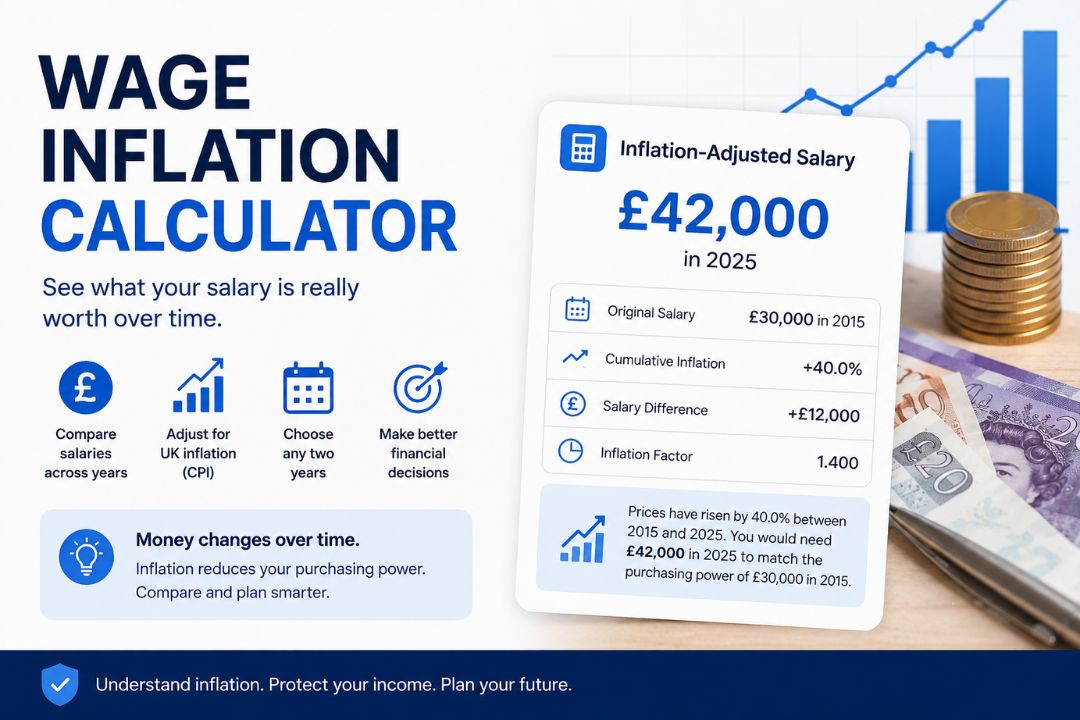
Wage Inflation Calculator
Compare the value of your salary between different years using UK Consumer Prices Index (CPI) data.
Inflation Factor = CPI in To Year ÷ CPI in From Year
Adjusted Salary = Original Salary × Inflation Factor
Wage Inflation Calculator UK: Compare Your Salary Across Different Years
A salary figure does not always tell the full story. Earning £30,000 today does not have the same purchasing power as earning £30,000 ten or twenty years ago because prices change over time. Inflation affects the cost of food, housing, transport, energy, clothing, services, and almost every other part of daily life. The Wage Inflation Calculator on CalQenix helps you understand how the value of a salary changes between different years by adjusting it using UK inflation data.
This calculator is designed for anyone who wants to compare wages across time. You can enter a salary amount, choose a starting year, choose a comparison year, and calculate the inflation-adjusted equivalent. The result shows how much money would be needed in the comparison year to have approximately the same purchasing power as the original salary.
The calculator can be useful for employees, job seekers, employers, students, researchers, financial planners, and anyone interested in understanding how inflation affects real earnings.
What Is a Wage Inflation Calculator?
A Wage Inflation Calculator is a financial tool that adjusts a salary or wage amount for inflation between two different years.
For example, imagine someone earned £25,000 in 2005. At first glance, that salary may seem lower than a modern salary of £35,000 or £40,000. However, prices were also lower in 2005. To make a fair comparison, the older salary needs to be adjusted for inflation.
The Wage Inflation Calculator does this by comparing Consumer Prices Index values from the selected years.
Instead of simply looking at the number printed on a payslip, the calculator estimates the equivalent purchasing power of that salary in another year.
This makes salary comparisons much more meaningful.
How Does the Wage Inflation Calculator Work?
Using the CalQenix Wage Inflation Calculator is simple.
First, enter the salary amount you want to compare.
Next, select the From Year. This is the year in which the original salary applies.
Then select the To Year. This is the year you want to compare the salary with.
Once you click the calculate button, the calculator uses UK CPI data to determine how much prices changed between those two years.
The calculator then applies the inflation factor to the original salary.
The result shows the approximate salary required in the comparison year to maintain the same purchasing power.
For example, if prices increased by 30% between two years, a salary of £30,000 in the earlier year would need to increase to approximately £39,000 to maintain similar purchasing power, assuming a simplified CPI-based comparison.
What Is Inflation?
Inflation is the general increase in the prices of goods and services over time.
When inflation occurs, each pound buys slightly less than before.
For example, if a basket of everyday products costs £100 this year and the same basket costs £105 next year, the price level has increased by approximately 5%.
This means that if your salary remains unchanged while prices increase, your purchasing power falls.
You may still earn the same amount of money, but that money may buy fewer goods and services.
This is why inflation is so important when comparing wages across different periods.
Why Salary Numbers Can Be Misleading
People often compare salaries without considering inflation.
Someone may say that their parent earned £20,000 per year decades ago while a similar job now pays £35,000. It might appear that modern workers are much better paid.
However, if the cost of living increased significantly during that period, the difference in real purchasing power may be much smaller.
The same applies when comparing your own salary growth.
Suppose your salary increased from £30,000 to £33,000 over several years.
A £3,000 increase sounds positive.
However, if inflation increased prices by 15% during the same period, your salary may actually have lost purchasing power.
A Wage Inflation Calculator helps make this difference visible.
Nominal Salary vs Real Salary
Understanding the difference between nominal salary and real salary is important when analysing wages.
Nominal salary is the actual amount of money you earn.
If your employer pays you £40,000 per year, your nominal salary is £40,000.
Real salary adjusts that amount for inflation.
Real salary focuses on what your income can actually buy.
For example, two employees earning £40,000 in different years may have very different standards of living because prices may be much higher in one year than the other.
The Wage Inflation Calculator converts nominal salary values into inflation-adjusted equivalents to make comparisons easier.
What Is the Consumer Prices Index?
The Consumer Prices Index, commonly known as CPI, is one of the main measures of inflation in the United Kingdom.
CPI tracks changes in the prices of a representative selection of goods and services purchased by households.
These can include food, clothing, transport, recreation, household goods, communication services, and many other categories.
When the overall cost of this representative basket increases, CPI rises.
By comparing CPI values from different years, it is possible to estimate how much the overall price level has changed.
The CalQenix Wage Inflation Calculator uses annual CPI values to estimate the inflation-adjusted value of salaries.
Wage Inflation Calculator Formula
The basic calculation used by the Wage Inflation Calculator is straightforward.
Inflation Factor = CPI in To Year ÷ CPI in From Year
Once the inflation factor is calculated, it is applied to the original salary.
Adjusted Salary = Original Salary × Inflation Factor
The calculator can also estimate cumulative inflation between the two selected years.
Cumulative Inflation = (Inflation Factor − 1) × 100
This allows users to see not only the adjusted salary but also the approximate percentage change in the general price level.
Wage Inflation Calculator Example
Imagine you want to compare a salary of £30,000 from an earlier year with a more recent year.
You enter £30,000 as the original salary.
You select the earlier year as the From Year.
You then select the newer year as the To Year.
The calculator retrieves the CPI index values for both years and calculates the inflation factor.
If the inflation factor is 1.40, the result would be:
£30,000 × 1.40 = £42,000
This means that approximately £42,000 in the comparison year would be required to have similar general purchasing power to £30,000 in the original year.
This does not mean every individual expense increased by exactly 40%. It is an overall estimate based on CPI.
What Does Cumulative Inflation Mean?
Cumulative inflation represents the total change in prices over the full period between two selected years.
This is different from the annual inflation rate.
For example, inflation may be 3% in one year, 4% in another year, and 2% in another. These changes compound over time.
Therefore, the total price increase over several years is not calculated simply by looking at one annual inflation figure.
The Wage Inflation Calculator compares the CPI index levels directly, which captures the combined change over the selected period.
If cumulative inflation is 25%, it means the general price level in the comparison year is approximately 25% higher than in the starting year.
How Inflation Affects Your Salary
Inflation can reduce the real value of your income if your wages do not rise at a similar rate.
Suppose you earn £35,000 and receive no salary increase for three years.
If prices increase significantly during those three years, your salary may still be £35,000 on paper, but your real purchasing power will be lower.
You may notice this through higher grocery bills, energy costs, rent, transport expenses, or other household costs.
This is sometimes referred to as a reduction in real wages.
A salary increase can also appear larger than it really is.
For example, a 5% pay rise during a period of 7% inflation means your nominal salary increased, but your real purchasing power may still have fallen.
What Is a Real Pay Rise?
A real pay rise occurs when your salary increases by more than inflation.
Suppose inflation is 4% and your employer increases your salary by 6%.
Your nominal salary rises by 6%, while average prices rise by approximately 4%.
The difference suggests that your real purchasing power has increased.
However, if your salary rises by only 2% while inflation is 5%, you receive a nominal pay rise but experience a real pay decrease.
The Wage Inflation Calculator can help you compare salaries across different years and understand whether wage growth kept pace with changes in the price level.
Why Use a Wage Inflation Calculator?
There are many reasons to use a Wage Inflation Calculator.
One common reason is salary negotiation.
Before accepting a new salary or negotiating a pay increase, you may want to compare your current salary with what it was worth several years ago.
Another reason is historical salary comparison.
If you are researching old job advertisements, employment records, government reports, or historical income figures, inflation adjustment allows you to understand what those salaries might represent in modern terms.
The calculator can also be useful when reviewing long-term career progression.
A person may see that their salary increased substantially over ten years, but adjusting for inflation may reveal that the improvement in real purchasing power was much smaller.
Using the Calculator for Salary Negotiations
Inflation-adjusted comparisons can provide useful context during salary discussions.
For example, suppose your salary has remained nearly unchanged for several years.
You can use a Wage Inflation Calculator to estimate how much your salary would need to be today to match the purchasing power it had when the salary was originally set.
This does not guarantee that an employer will increase your salary to that amount.
Pay decisions depend on many factors, including performance, company finances, job demand, skills, experience, industry conditions, and local labour markets.
However, inflation-adjusted salary information can provide an additional reference point when evaluating compensation.
Comparing Job Offers from Different Years
The calculator can also help when comparing job offers or career history.
Suppose you were offered £28,000 several years ago and are now considering a similar position paying £34,000.
The newer salary is obviously higher in nominal terms.
However, adjusting the older salary for inflation may show that £28,000 in the earlier year is equivalent to around £35,000 today.
In that case, the modern £34,000 offer may actually represent slightly lower real purchasing power.
This kind of comparison can be useful when evaluating long-term changes in salary levels.
Wage Inflation and the Cost of Living
Inflation and the cost of living are related, but they are not exactly the same.
CPI measures average price changes across a broad basket of goods and services.
Your personal cost of living depends on how you spend your money.
For example, someone who spends a large percentage of their income on rent and energy may experience inflation differently from someone who owns their home outright.
Families with children may have different expenses from single adults.
People living in London may face very different housing costs from people living in other parts of the UK.
For this reason, the calculator provides a general inflation-adjusted estimate rather than a personalised cost-of-living calculation.
Can I Compare a Newer Salary with an Older Year?
Yes.
The CalQenix Wage Inflation Calculator can also calculate backwards.
For example, you may want to know what a salary of £50,000 today would be approximately equivalent to in an earlier year.
The calculator uses the same CPI relationship but reverses the comparison.
This can be useful when reading historical salary data or trying to understand how modern income figures compare with past earnings.
Does the Calculator Include Tax?
No.
The Wage Inflation Calculator compares gross salary values based on inflation.
It does not calculate Income Tax, National Insurance, pension contributions, student loan repayments, or other deductions.
Tax systems can change significantly over time, so comparing take-home pay between different years requires a different type of calculation.
Two inflation-adjusted gross salaries may result in different net incomes because tax thresholds and rates may have changed.
The result should therefore be considered an inflation-adjusted salary comparison rather than a take-home pay calculator.
Does the Calculator Predict Future Inflation?
No.
The calculator is designed primarily to compare years for which annual CPI data is available.
Future inflation cannot be known with certainty.
Economists, governments, central banks, and financial institutions may publish forecasts, but actual inflation can differ from predictions due to energy prices, interest rates, supply disruptions, exchange rates, economic growth, government policy, international events, and many other factors.
For this reason, historical calculations are generally more reliable than future projections.
Is the Wage Inflation Calculator Accurate?
The calculator uses CPI-based calculations, which provide a useful general estimate of changes in purchasing power.
However, no inflation calculator can perfectly describe the financial experience of every person.
Your personal inflation rate depends on what you buy.
If rent represents a large percentage of your budget and rent rises much faster than CPI, your real cost pressures may be greater than the calculator suggests.
Alternatively, if you spend less on categories experiencing large price increases, your personal inflation rate may be lower.
The result should therefore be viewed as a general economic comparison rather than an exact measure of personal finances.
Wage Growth vs Inflation
Wage growth and inflation are two important economic indicators.
Wage growth measures how earnings change over time.
Inflation measures how prices change over time.
When wages grow faster than inflation, workers may experience rising real incomes.
When inflation grows faster than wages, purchasing power may fall.
This relationship can affect consumer spending, household finances, savings, borrowing, and living standards.
Using a Wage Inflation Calculator makes it easier to understand this relationship on an individual salary level.
How to Use Your Result
After calculating an inflation-adjusted salary, compare it with your actual salary in the selected year.
Suppose your original salary was £30,000 and the calculator says you would need £40,000 today to maintain equivalent purchasing power.
If your actual modern salary is £45,000, your income has increased faster than the calculated inflation adjustment.
If your salary is £38,000, your nominal income has increased, but it may not have fully kept pace with inflation.
This simple comparison can provide useful perspective on real wage progression.
Limitations of Wage Inflation Calculations
Inflation calculations are helpful, but they have limitations.
CPI represents an average across the economy.
It cannot account for individual spending habits, regional housing differences, changes in taxation, changes in product quality, lifestyle changes, family size, debt costs, or personal financial circumstances.
Salary value is also influenced by benefits that may not appear in gross pay.
For example, pension contributions, bonuses, private health insurance, remote working, paid leave, company vehicles, and flexible working arrangements can significantly affect the overall value of employment.
Therefore, an inflation-adjusted salary should be considered one part of a broader financial comparison.
Frequently Asked Questions About Wage Inflation
What salary would I need today to match my old salary?
Enter your old salary as the Salary Amount, choose the year you earned it as the From Year, and choose the latest available year as the To Year. The calculator will estimate the inflation-adjusted equivalent.
Can I use monthly wages instead of annual salary?
Yes. The mathematical inflation adjustment works with any monetary amount. You can enter a monthly wage, weekly wage, pension amount, savings figure, or another amount, although the result labels may refer to salary.
Why is my adjusted salary higher?
If the CPI level increased between your starting year and comparison year, prices became higher overall. Therefore, a larger amount of money is needed in the newer year to match the purchasing power of the earlier salary.
Can inflation ever produce a lower adjusted salary?
Yes. If you compare a newer year with an older year, the equivalent amount in the older year will usually be lower because the general price level was lower.
Does the calculator measure my exact cost of living?
No. It uses general CPI data and cannot account for your individual household expenses.
Final Thoughts
The Wage Inflation Calculator is a simple but useful tool for understanding how the real value of money changes over time.
A salary may increase significantly in nominal terms while providing only a modest improvement in purchasing power. In some cases, an employee can receive several pay rises and still find that their real income has barely changed because prices increased at a similar or faster rate.
By comparing wages using CPI, the CalQenix Wage Inflation Calculator provides a clearer way to evaluate salaries across different years.
You can use it to review your career earnings, analyse historical salaries, understand the impact of inflation, prepare for salary negotiations, compare job offers, or simply explore how much the value of money has changed.
The most important thing to remember is that inflation-adjusted salary is an estimate of general purchasing power. It does not measure every aspect of your personal finances.
Taxes, housing costs, lifestyle, location, benefits, debt, savings, and individual spending patterns can all affect how far your salary actually goes.
Still, when you need a quick and easy way to compare the value of a wage between two different years, the CalQenix Wage Inflation Calculator provides a practical starting point for understanding the impact of inflation on your earnings.
