Swimming Pace Calculator
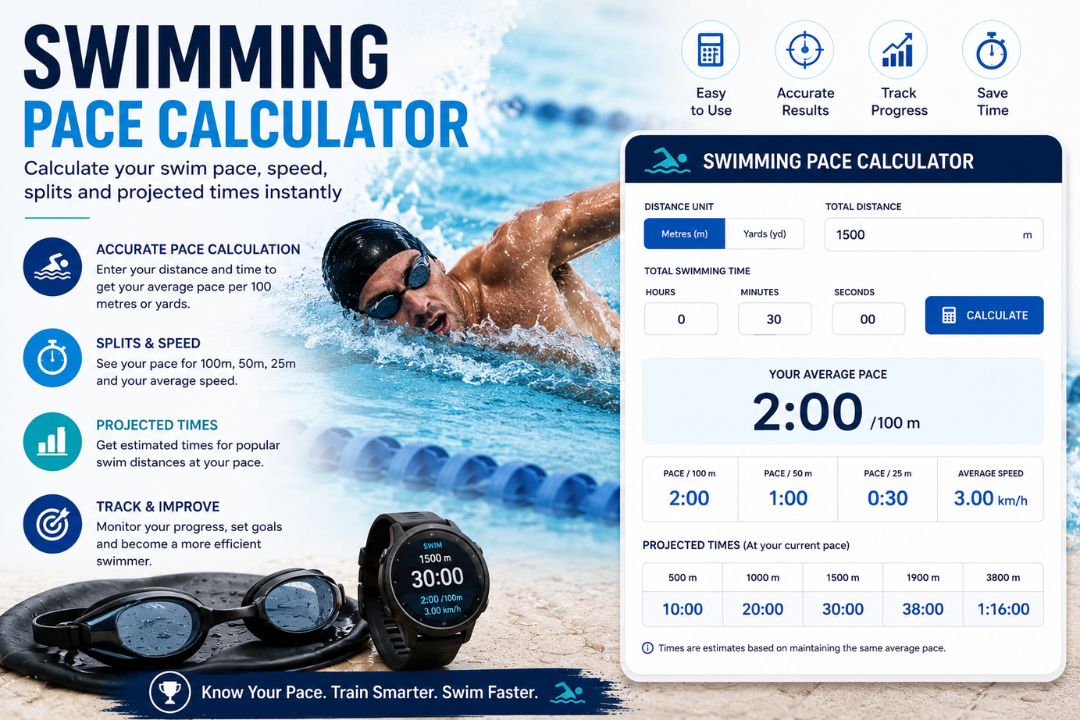
Enter your swimming distance and total time to calculate your pace per 100 metres or yards, splits and average speed.
Projected Swim Times
Estimated times if you maintain the same pace.
Pace per 100 = Total Time ÷ Distance × 100
Average Speed = Distance ÷ Total Time
Swimming Pace Calculator: Calculate Your Swim Pace, Speed and Split Times
Swimming is one of the most effective full-body exercises, but improving in the water requires more than simply swimming longer distances. Understanding your pace can help you train more efficiently, compare performances, set realistic goals, and prepare for races. The Swimming Pace Calculator on CalQenix is designed to make this process simple by calculating your average pace based on the distance you swim and the time it takes you to complete it.
Instead of manually dividing minutes and seconds by distance, you can enter your total swim distance and total swimming time, select whether you are swimming in metres or yards, and let the calculator work out your pace automatically. The tool can show your average pace per 100 metres or 100 yards, shorter split times, average speed, and projected times for common swimming distances.
Whether you are a beginner learning how to monitor your swimming progress, a recreational swimmer trying to become more consistent, a triathlete preparing for an event, or a competitive swimmer working on pacing strategy, this calculator provides a quick way to understand your swimming performance.
What Is a Swimming Pace Calculator?
A Swimming Pace Calculator is an online tool that calculates how long it takes you, on average, to swim a specific distance.
Swimming pace is commonly expressed as the time required to swim 100 metres or 100 yards.
For example, if a swimmer completes 1,000 metres in 20 minutes, the swimmer’s average pace is 2 minutes per 100 metres.
This is normally written as:
2:00 per 100 m
The same principle applies to yards.
If you complete 1,000 yards in 18 minutes, the calculator can determine your average time per 100 yards.
Pace is one of the most useful measurements for swimmers because it allows performances over different distances to be compared more easily.
How to Use the Swimming Pace Calculator
Using the CalQenix Swimming Pace Calculator is simple.
First, choose whether your swimming distance is measured in metres or yards.
Next, enter the total distance you completed.
For example, you could enter 500 metres, 1,000 metres, 1,500 metres, 1,900 metres, or any other distance.
Then enter your total swimming time using hours, minutes, and seconds.
If your swim took 32 minutes and 45 seconds, you would enter:
Hours: 0
Minutes: 32
Seconds: 45
After entering the information, select Calculate Swimming Pace.
The calculator will determine your average pace and display additional performance information.
Swimming Pace Formula
The basic formula for swimming pace is straightforward.
Pace per 100 = Total Time ÷ Distance × 100
The total time and distance must use compatible units.
For example, suppose you swim 1,500 metres in 30 minutes.
Thirty minutes equals 1,800 seconds.
The calculation would be:
1,800 ÷ 1,500 × 100 = 120 seconds
120 seconds equals 2 minutes.
Your swimming pace would therefore be:
2:00 per 100 m
The calculator performs this conversion automatically, so you do not need to manually convert hours, minutes, and seconds into one time unit.
Why Is Swimming Pace Important?
Swimming pace helps you understand how efficiently and consistently you are moving through the water.
Simply knowing your total swim time does not always provide enough information.
For example, swimming 1,500 metres in 30 minutes and swimming 3,000 metres in 60 minutes represent the same average pace.
Both swims are completed at approximately 2:00 per 100 metres.
By focusing on pace, you can compare performances across different distances.
This makes pace especially valuable when monitoring progress over several weeks or months.
If your pace improves from 2:10 per 100 metres to 2:00 per 100 metres, you can clearly see that you are swimming faster, even if the total distances of your training sessions are different.
Understanding Pace per 100 Metres
Pace per 100 metres is one of the most common ways swimmers monitor performance.
It tells you how much time you need, on average, to complete every 100 metres of your swim.
For example:
1:30 per 100 m means you swim 100 metres in approximately 1 minute and 30 seconds.
2:00 per 100 m means you swim 100 metres in approximately 2 minutes.
2:30 per 100 m means you swim 100 metres in approximately 2 minutes and 30 seconds.
A lower time means a faster swimming pace.
If your pace changes from 2:10 to 2:00 per 100 metres, you have improved by 10 seconds per 100 metres.
That difference can become significant over longer distances.
Pace per 100 Yards
Many swimming pools, particularly in countries that commonly use imperial measurements, are measured in yards.
The same pace concept applies.
If you complete 500 yards in 10 minutes, the pace calculation would be:
10 minutes ÷ 5 = 2 minutes per 100 yards
Your average pace would be 2:00 per 100 yd.
It is important to know whether a pool is measured in metres or yards because 100 metres and 100 yards are not the same distance.
A swimmer’s pace per 100 yards will therefore not directly match their pace per 100 metres.
The CalQenix calculator allows you to select the correct measurement system before calculating your result.
What Are Swimming Splits?
A split is the time taken to complete part of a swimming distance.
Common split distances include 25 metres, 50 metres, and 100 metres.
For example, if your average pace is 2:00 per 100 metres, an evenly paced 50-metre split would be approximately 1:00.
A 25-metre split would be approximately 30 seconds.
Splits are useful during training because they allow swimmers and coaches to track pace throughout a workout.
Instead of waiting until the end of a long swim to evaluate performance, you can compare individual splits and see whether your pace remained consistent.
Why Consistent Splits Matter
Swimming fast at the beginning of a workout or race can feel good, but starting too quickly can lead to fatigue.
A swimmer who completes the first 100 metres much faster than the target pace may struggle to maintain the same speed later.
Consistent pacing can help conserve energy and produce a stronger overall performance.
For example, suppose your target pace for a 1,500-metre swim is 2:00 per 100 metres.
Ideally, most of your 100-metre splits would remain close to two minutes.
If the early splits are around 1:45 but the final splits fall to 2:20, the average may still look reasonable, but the pacing strategy was inconsistent.
Tracking split times can help identify this problem.
Average Swimming Speed
The Swimming Pace Calculator can also estimate average swimming speed.
Speed describes how much distance you cover during a specific amount of time.
For metres, average speed can be displayed in kilometres per hour.
The basic formula is:
Average Speed = Distance ÷ Time
Suppose you swim 1,000 metres in 20 minutes.
This means you swim one kilometre in one-third of an hour.
Your average speed would therefore be approximately 3 kilometres per hour.
Speed is useful for comparing swimming with other endurance activities, but swimmers often prefer pace because it is more practical during training.
Swimming Pace vs Swimming Speed
Pace and speed describe the same performance from different perspectives.
Swimming speed tells you how much distance you cover over time.
Swimming pace tells you how much time you require to cover a specific distance.
A faster swimmer has a higher speed but a lower pace time.
For example, a swimmer averaging 1:30 per 100 metres is faster than a swimmer averaging 2:00 per 100 metres.
Although 1:30 is a smaller number, it represents less time needed to complete the same distance.
This difference sometimes causes confusion for new swimmers.
Swimming Pace Example for 500 Metres
Suppose you swim 500 metres in 10 minutes.
There are five 100-metre sections in 500 metres.
The calculation is:
10 minutes ÷ 5 = 2 minutes
Your average pace is:
2:00 per 100 m
Your average 50-metre split would be approximately:
1:00
Your average 25-metre split would be approximately:
30 seconds
If you maintained the same pace for 1,000 metres, your projected time would be approximately 20 minutes.
Swimming Pace Example for 1,500 Metres
A 1,500-metre swim is commonly used in endurance swimming and triathlon training.
Suppose you complete 1,500 metres in 27 minutes.
Twenty-seven minutes equals 1,620 seconds.
The pace calculation is:
1,620 ÷ 1,500 × 100 = 108 seconds
108 seconds equals:
1 minute 48 seconds
Your average pace would therefore be approximately:
1:48 per 100 m
Maintaining this pace for longer distances can help estimate future swim times.
Swimming Pace for Triathlon Training
Swimming pace is particularly useful for triathletes.
The swim section of a triathlon may represent only one part of the event, but swimming too aggressively can reduce the energy available for cycling and running.
Triathletes can use pace calculations to determine a sustainable swimming intensity.
For example, if your comfortable training pace is 2:00 per 100 metres, attempting to maintain 1:40 per 100 metres during a long open-water swim may lead to unnecessary fatigue.
A Swimming Pace Calculator allows athletes to compare training sessions and estimate likely race times based on current pace.
Common Triathlon Swim Distances
Several common triathlon formats use standard swim distances.
A sprint-distance triathlon may include approximately 750 metres of swimming.
An Olympic-distance triathlon commonly includes a 1,500-metre swim.
A half-distance event may include approximately 1.9 kilometres of swimming.
A full-distance event may include approximately 3.8 kilometres of swimming.
The projected times displayed by a pace calculator can help athletes estimate how long these distances might take if they maintain their current average pace.
Projected Swim Times
Projected swim times estimate how long another distance could take if you maintain exactly the same pace.
For example, suppose your current pace is 2:00 per 100 metres.
At that pace:
500 metres would take approximately 10 minutes.
1,000 metres would take approximately 20 minutes.
1,500 metres would take approximately 30 minutes.
1,900 metres would take approximately 38 minutes.
3,800 metres would take approximately 1 hour and 16 minutes.
These are mathematical projections rather than guarantees.
Maintaining the same pace over a much longer distance can be difficult because fatigue increases as distance increases.
Can I Use Swimming Pace to Plan Training?
Yes.
Pace can be used to create structured swimming workouts.
For example, if your normal pace is 2:00 per 100 metres, you might perform several 100-metre repetitions around that pace.
A training session could include:
Easy repetitions slightly slower than normal pace.
Steady repetitions close to normal pace.
Faster repetitions below normal pace time.
This type of structured pacing can help improve endurance, speed, and consistency.
However, appropriate training intensity varies between swimmers.
Beginners should focus heavily on technique and comfort rather than trying to swim every workout at maximum speed.
How Can I Improve My Swimming Pace?
Improving swimming pace is not simply about moving your arms and legs faster.
Swimming efficiency plays a major role.
Good body position can reduce drag.
Effective breathing can help maintain rhythm.
A strong catch can improve propulsion.
Proper kicking can support balance and speed.
Good turns can reduce unnecessary time in the pool.
Consistent training can also improve cardiovascular fitness and muscular endurance.
Swimmers who want to become faster should often focus first on improving technique because small technical changes can produce meaningful improvements without requiring significantly more energy.
Does Stroke Type Affect Swimming Pace?
Yes.
Different swimming strokes have different typical speeds.
Freestyle is generally the fastest and most commonly used stroke for pace-based endurance training.
Backstroke, breaststroke, and butterfly each have different movement patterns and energy demands.
A 2:00 per 100-metre freestyle pace cannot necessarily be compared directly with a 2:00 breaststroke pace.
When tracking progress, it is best to compare sessions using the same stroke and similar conditions.
Pool Swimming vs Open-Water Swimming
Swimming pace in a pool may differ from swimming pace in open water.
Pools provide walls for turns, lane markings for navigation, controlled distances, and usually calmer water.
Open-water swimming may involve waves, currents, wind, navigation, contact with other swimmers, and no wall push-offs.
A swimmer who maintains 1:50 per 100 metres in a pool may not automatically maintain the same pace in open water.
Wetsuits can also affect swimming speed and body position.
For these reasons, race predictions based on pool pace should be treated as estimates.
Does Pool Length Affect Pace?
Yes, pool length can influence swimming times.
A 25-metre pool involves more turns than a 50-metre pool over the same total distance.
Strong swimmers may benefit from additional wall push-offs in shorter pools.
This can produce faster average times compared with swimming the same distance in a longer pool.
A 25-yard pool also differs from a 25-metre pool because yards are shorter than metres.
When comparing swim performances, always consider pool length and measurement unit.
Why Did My Pace Change During the Same Workout?
Swimming pace can change for many reasons.
Fatigue is one of the most common.
Your technique may become less efficient as you become tired.
Rest periods can also affect performance.
A swimmer completing short repetitions with generous recovery may swim much faster than during a continuous long-distance effort.
Warm-up, water temperature, hydration, sleep, nutrition, and training load can all influence pace.
For accurate progress tracking, compare workouts under similar conditions whenever possible.
Is Faster Always Better?
Not necessarily.
Training at maximum speed all the time can lead to poor technique, excessive fatigue, and inconsistent progress.
Different workouts have different purposes.
Easy swimming can improve recovery and technique.
Steady swimming can build aerobic endurance.
Threshold sessions can improve sustainable speed.
Sprint work can improve power and top-end speed.
Therefore, a slower pace during an easy training session does not necessarily mean your fitness is getting worse.
Pace should always be interpreted in the context of the workout.
What Is a Good Swimming Pace?
There is no single swimming pace that is good for everyone.
Swimming ability varies widely depending on age, experience, fitness, stroke technique, distance, training history, and goals.
A beginner may be pleased to maintain a comfortable and consistent pace over several hundred metres.
An experienced competitive swimmer may target significantly faster splits.
Instead of comparing yourself with other swimmers, it is often more useful to track your own progress.
If you previously averaged 2:20 per 100 metres and now consistently swim 2:10 per 100 metres at the same effort, that is meaningful improvement.
Can I Calculate Pace for Short Distances?
Yes.
The calculator can be used for short distances such as 25, 50, 100, or 200 metres or yards.
However, pace calculations over very short distances can be strongly influenced by the start, dive, and turn.
For example, a 50-metre sprint pace projected over 1,500 metres would probably be unrealistic because swimmers cannot normally maintain sprint intensity for long periods.
Projected times are most useful when the original swim and target distance require reasonably similar effort levels.
Can I Calculate Pace for Long Swims?
Yes.
You can enter long distances such as 2,000 metres, 3,000 metres, 3,800 metres, or even longer distances.
The same formula applies.
For swims lasting longer than one hour, enter the number of hours as well as minutes and seconds.
The calculator converts everything into a single time value before calculating pace.
How Accurate Is the Swimming Pace Calculator?
The mathematical pace calculation is accurate when the entered distance and time are correct.
However, projected future times are estimates.
The calculator assumes you can maintain exactly the same average pace over another distance.
In reality, performance may change because of fatigue, rest intervals, stroke changes, turns, water conditions, race pressure, or pacing strategy.
For this reason, use projected times as planning estimates rather than guaranteed race results.
Common Swimming Pace Calculation Mistakes
One common mistake is mixing metres and yards.
Another is entering minutes as decimal time.
For example, 1 minute and 30 seconds is not 1.30 minutes mathematically.
It equals 1.5 minutes.
Using separate hour, minute, and second fields helps prevent this problem.
Another mistake is calculating pace based only on the total number of pool lengths without knowing the length of the pool.
Twenty lengths of a 25-metre pool equals 500 metres.
Twenty lengths of a 50-metre pool equals 1,000 metres.
Always calculate the actual distance first.
Why Use the CalQenix Swimming Pace Calculator?
The CalQenix Swimming Pace Calculator is designed to make swim analysis simple.
You can calculate your main pace without manually converting times.
You can choose between metres and yards.
You can see estimated 25, 50, and 100 distance splits.
You can check your average speed.
You can also view projected times for several common swimming and triathlon distances.
These features make the calculator useful both for quick calculations and ongoing training analysis.
Frequently Asked Questions
How do I calculate swimming pace per 100 metres?
Divide your total swim time by the total distance and multiply the result by 100.
Is a lower swimming pace better?
A lower time per 100 metres or yards indicates faster swimming.
Can I use yards instead of metres?
Yes. Select yards before entering your distance.
Can I calculate my 50-metre split?
Yes. The calculator estimates your average 50-unit split using your overall pace.
Does the calculator work for open-water swimming?
Yes, as long as you know your total distance and time, although open-water conditions can make projected results less predictable.
Can I use it for triathlon swim times?
Yes. The projected distance feature can be useful for estimating common triathlon swim times.
Does the calculator account for rest breaks?
The calculator simply uses the total time you enter. If your time includes rest, the calculated pace will also include those rest periods.
Final Thoughts
The Swimming Pace Calculator is a practical tool for anyone who wants to better understand swimming performance.
By converting distance and total time into a simple pace per 100 metres or yards, the calculator makes it easier to compare sessions, set training targets, evaluate progress, and estimate future swim times.
Pace is particularly valuable because it works across many different distances.
Instead of focusing only on whether you completed a workout faster than before, you can analyse how efficiently you covered each 100 metres or yards.
The CalQenix Swimming Pace Calculator also provides shorter splits, average speed, and projected times to give you a broader view of your performance.
Remember that swimming performance is influenced by more than numbers.
Technique, fatigue, pool length, stroke type, water conditions, turns, starts, and training goals can all affect your results.
Use the calculator as a planning and analysis tool rather than treating every projected time as a guaranteed result.
Whether you are swimming for fitness, training for a triathlon, preparing for a competition, or simply trying to become more consistent in the pool, tracking your pace can provide useful feedback and help you make smarter training decisions.
