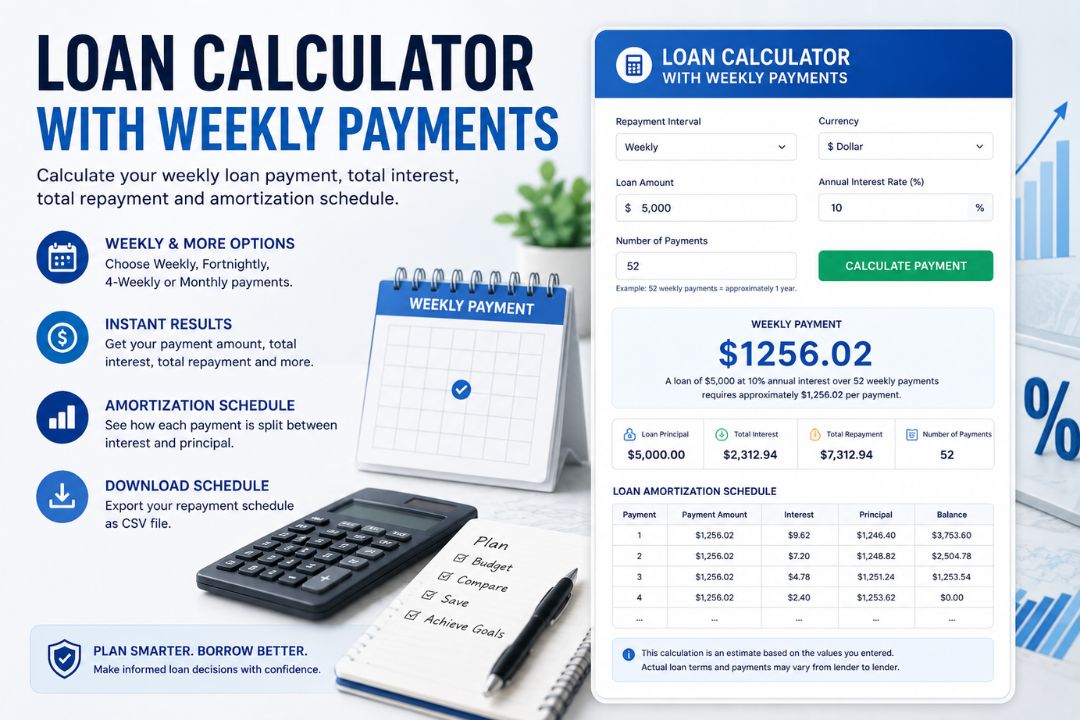
Loan Calculator with Weekly Payments
Calculate your weekly loan repayment, total interest, total repayment and complete amortization schedule.
Loan Cost Breakdown
See how your total repayment is divided between principal and interest.
Loan Amortization Schedule
Weekly repayment breakdown.
| Payment | Payment Amount | Interest | Principal | Balance |
|---|
Payment = P × r × (1 + r)n ÷ [(1 + r)n − 1]
P = loan principal, r = interest rate per payment period, n = total number of payments.
Loan Calculator with Weekly Payments: Calculate Weekly Loan Repayments Easily
A loan can seem simple when you only look at the amount borrowed, but the true cost depends on several factors, including the interest rate, repayment frequency, and number of payments. If your loan is repaid every week rather than every month, it can be difficult to estimate your exact repayment amount manually. The Loan Calculator with Weekly Payments on CalQenix is designed to make this calculation easier by showing your estimated weekly payment, total interest, total repayment, loan term, and complete amortization schedule.
This calculator is useful for personal loans, short-term borrowing, vehicle finance, small business loans, instalment agreements, and other fixed-rate loans where repayments are made on a regular schedule. You can enter your loan amount, annual interest rate, repayment interval, and number of payments to calculate how much you may need to pay each week or during another selected repayment period.
The calculator also shows how each payment is divided between interest and principal, helping you understand how your outstanding balance falls over time.
What Is a Weekly Loan Payment Calculator?
A weekly loan payment calculator is an online financial tool that estimates the regular repayment required to pay off a fixed-rate loan over a specified number of weekly payments.
Instead of using a monthly interest rate and monthly repayments, the calculator converts the annual interest rate into a rate that matches the selected payment frequency.
For weekly repayments, an annual interest rate is divided according to 52 payment periods per year.
The calculator then uses a standard amortization formula to determine the regular payment.
This approach is different from simply dividing the total loan amount by the number of weeks because interest is charged on the remaining balance throughout the loan term.
How to Use the Loan Calculator with Weekly Payments
Using the CalQenix calculator is straightforward.
Start by selecting your repayment interval.
If you want to calculate weekly loan payments, select Weekly.
You can also choose another repayment frequency if you want to compare different payment schedules.
Next, choose the currency you want to use.
Then enter the total amount you plan to borrow.
For example, you may enter 5,000, 10,000, or any other loan amount.
After that, enter the annual interest rate.
If your loan has a 10% annual interest rate, enter 10.
Finally, enter the number of repayments.
For a one-year weekly loan, you may enter approximately 52 payments.
Once all values have been entered, select Calculate Loan Payment.
The calculator will instantly estimate your periodic repayment and provide a detailed repayment breakdown.
Weekly Loan Payment Formula
The calculator uses the standard fixed-payment loan formula.
Payment = P × r × (1 + r)^n ÷ [(1 + r)^n − 1]
In this formula:
P represents the original loan principal.
r represents the interest rate per payment period.
n represents the total number of payments.
Before the payment can be calculated, the annual interest rate must be converted into a weekly rate.
For a weekly repayment schedule:
Weekly Interest Rate = Annual Interest Rate ÷ 52
The percentage rate must also be converted into decimal form.
For example, an annual rate of 10% becomes 0.10.
The approximate weekly rate would therefore be:
0.10 ÷ 52 = 0.001923
The formula then uses this periodic rate together with the loan balance and number of payments.
Weekly Loan Payment Example
Suppose you borrow 5,000 at an annual interest rate of 10% and agree to repay the loan over 52 weekly payments.
The annual interest rate is first converted to a weekly rate.
10% ÷ 52 gives an approximate weekly rate of 0.1923%.
The calculator then applies the amortization formula.
The resulting weekly payment will include both interest and repayment of the original principal.
Each week, part of the payment covers interest charged on the outstanding balance, while the rest reduces the amount still owed.
As the balance falls, the interest part of future payments usually becomes smaller and the principal portion becomes larger.
What Is Loan Principal?
Loan principal is the original amount borrowed before interest and other potential charges are added.
If you borrow 20,000, the principal is 20,000.
The principal is important because interest is generally calculated based on the outstanding balance.
At the beginning of the loan, the outstanding principal is highest.
As you make repayments, the principal gradually decreases.
The CalQenix calculator displays the original principal separately from total interest so you can clearly see how much of your total repayment represents borrowed money and how much represents financing cost.
What Is the Interest Rate?
The interest rate is the cost charged by a lender for allowing you to borrow money.
Loan rates are commonly quoted as annual percentages.
For example, a loan may have an annual interest rate of 8%, 10%, or 15%.
A higher interest rate generally results in a larger repayment and greater total interest cost, assuming all other loan terms remain the same.
When repayments occur weekly, the calculator converts the annual rate into an appropriate weekly rate before determining the payment.
This is important because using the annual percentage directly as a weekly rate would produce a completely incorrect result.
Weekly Interest Rate vs Annual Interest Rate
The annual interest rate represents the rate over a full year.
The weekly rate represents the portion applied to each weekly payment period.
For example, if the annual rate is 5%, the weekly rate in a simplified nominal calculation would be:
5% ÷ 52 = approximately 0.0962% per week
A weekly rate appears much smaller than the annual rate because it applies to a much shorter period.
However, interest is calculated repeatedly over the repayment schedule.
This is why the repayment formula needs to consider both the periodic rate and the total number of payments.
What Does Number of Payments Mean?
The number of payments tells the calculator how many instalments will be made before the loan is fully repaid.
For a weekly repayment schedule:
52 payments represent approximately one year.
104 payments represent approximately two years.
156 payments represent approximately three years.
A greater number of payments usually reduces the amount required each week because the loan is spread across a longer period.
However, extending the repayment term can also increase the total interest paid because the outstanding balance remains open for longer.
This creates an important trade-off between affordable repayments and the total cost of borrowing.
Shorter Loan Term vs Longer Loan Term
A shorter repayment period generally results in larger weekly payments.
However, because the balance is repaid more quickly, total interest may be lower.
A longer repayment period reduces the size of each weekly payment, which can make budgeting easier.
The disadvantage is that you may pay more interest overall.
For example, a 10,000 loan repaid over one year may require relatively high weekly instalments.
Repaying the same loan over three years may significantly reduce the weekly amount, but interest will continue to accumulate for a longer period.
The Loan Calculator with Weekly Payments allows you to test both scenarios before making a decision.
What Is Total Interest?
Total interest is the difference between the total amount repaid and the original principal.
For example, suppose you borrow 10,000 and eventually repay 11,500.
Your total interest cost would be approximately:
11,500 − 10,000 = 1,500
This figure is useful because it shows the overall cost of financing the loan, excluding any other lender charges that are not included in the calculator.
A small difference in interest rate or loan term can sometimes produce a large difference in total interest.
For this reason, comparing total interest can be just as important as comparing weekly repayment amounts.
What Is Total Repayment?
Total repayment is the complete amount paid during the loan term.
It includes the original loan principal plus the total interest generated by the calculator.
For example:
Loan principal = 8,000
Total interest = 1,200
Total repayment = 9,200
The calculator shows this amount so you can understand the overall financial commitment rather than focusing only on individual instalments.
A loan with a small weekly payment may still be expensive if it continues for many years.
What Is an Amortization Schedule?
An amortization schedule is a table showing every repayment during the life of a loan.
The CalQenix calculator displays a schedule containing:
Payment number
Payment amount
Interest paid
Principal repaid
Remaining balance
This schedule can help you understand exactly how the loan is gradually repaid.
In a typical fixed-rate amortizing loan, the payment amount remains relatively stable.
However, the composition of the payment changes over time.
Early payments may contain a larger proportion of interest.
Later payments contain more principal as the outstanding balance decreases.
Why Does Interest Decrease Over Time?
Interest is normally calculated using the remaining loan balance.
At the beginning of the repayment period, the balance is close to the full original loan amount.
Therefore, the interest charged during early periods is relatively high.
After each payment, part of the principal is repaid.
This reduces the outstanding balance.
Because future interest is calculated on a smaller amount, the interest portion gradually decreases.
This is why the principal portion of each payment often increases as the loan approaches its final repayment.
The amortization schedule makes this process easy to see.
Weekly Payments vs Monthly Payments
Weekly and monthly payments can produce different repayment schedules.
Weekly repayment plans require more frequent payments.
There are approximately 52 weekly periods in a year compared with 12 monthly periods.
Some borrowers prefer weekly repayments because they match a weekly income schedule.
Others prefer monthly repayments because fewer transactions are required.
The best option depends on the lender's terms and your personal budgeting preferences.
The CalQenix calculator allows you to switch between weekly and other intervals to compare repayment structures.
Weekly Payments vs Fortnightly Payments
Fortnightly payments usually occur every two weeks.
There are approximately 26 fortnightly repayment periods in one year.
Someone paid every two weeks may find fortnightly loan payments easier to manage than weekly payments.
The calculator can estimate these payments by using a periodic interest rate based on 26 repayment periods per year.
The same general amortization formula applies.
Only the repayment frequency changes.
Does Paying Weekly Save Interest?
Not automatically.
Whether weekly repayments reduce interest depends on how the loan agreement is structured, how the lender calculates interest, and whether weekly payments cause the principal to reduce earlier.
If a lender simply divides an equivalent annual repayment schedule into smaller weekly instalments, the interest difference may be limited.
However, if payments are applied to the balance more frequently, the timing may affect the amount of interest charged.
Always confirm the exact calculation method used by your lender.
The CalQenix calculator uses a standard fixed-rate repayment model and should be treated as an estimate.
Can I Use the Calculator for Personal Loans?
Yes.
The calculator can be useful for estimating repayments on many personal fixed-rate loans.
For example, you can use it to estimate payments for:
Debt consolidation loans
Home improvement loans
Education loans
Emergency borrowing
Wedding financing
Travel loans
General personal borrowing
The calculator does not determine whether you qualify for a loan.
It simply estimates repayments based on the financial values you enter.
Can I Use It for Car Loans?
Yes, if the vehicle loan uses a standard fixed-rate amortizing repayment structure.
Enter the financed amount rather than necessarily entering the full vehicle price.
For example, if a car costs 25,000 and you provide a 5,000 deposit, the financed amount may be 20,000.
Enter the appropriate interest rate and repayment schedule to estimate the instalment.
Actual car finance may include arrangement fees, balloon payments, residual values, insurance products, or other conditions that require separate consideration.
Can Businesses Use a Weekly Loan Calculator?
Yes.
Small businesses may use weekly repayment schedules for short-term financing, equipment purchases, working capital loans, or other borrowing.
A calculator can help estimate whether weekly payments fit expected cash flow.
However, business finance arrangements may include fees or interest structures that differ from standard consumer loans.
The result should therefore be used as a planning estimate rather than a replacement for the lender's formal repayment schedule.
What Happens if the Interest Rate Is 0%?
A zero-interest loan does not require the normal interest formula.
If the interest rate is 0%, the calculator simply divides the principal by the number of repayments.
For example, a 5,200 interest-free loan repaid over 52 weeks would require:
5,200 ÷ 52 = 100 per week
The total repayment would remain 5,200 because no interest is added.
Why Is My Final Payment Slightly Different?
Loan calculations often produce amounts containing many decimal places.
Financial payments are normally rounded to two decimal places.
Over dozens or hundreds of payments, tiny rounding differences can accumulate.
As a result, the final payment may need to be adjusted slightly so the remaining balance reaches exactly zero.
The calculator handles this internally when generating the amortization schedule.
A lender may use its own rounding policy, so the final payment shown on an actual loan agreement may vary slightly.
How Can I Reduce My Weekly Loan Payment?
There are several ways a weekly payment can theoretically be reduced.
Borrow a smaller amount.
Obtain a lower interest rate.
Extend the repayment period.
Make a larger deposit before financing a purchase.
However, extending the repayment term should be considered carefully because it may increase total interest.
A lower weekly payment is not always the cheapest loan.
Use the calculator to compare both payment size and total repayment cost.
How Can I Reduce Total Loan Interest?
One of the most effective ways to reduce interest is to repay the loan faster, provided there are no penalties or restrictions.
You may also reduce interest by obtaining a lower annual rate or borrowing less.
Some borrowers make additional principal payments.
If permitted by the lender, extra payments can reduce the outstanding balance and potentially lower future interest.
The standard calculator assumes the regular payment schedule and does not automatically include additional repayments unless they are reflected in the inputs.
Does the Calculator Include Fees?
No.
The main calculator estimates principal and interest using the entered annual interest rate.
It does not automatically include application fees, origination fees, late charges, insurance, taxes, broker fees, account charges, early repayment penalties, or other costs.
These charges can affect the true cost of borrowing.
Before accepting any loan, review the lender's complete disclosure and repayment information.
Interest Rate vs APR
Interest rate and APR are related but can represent different things.
The stated interest rate usually describes the cost of borrowing before certain fees.
APR, or Annual Percentage Rate, may include additional charges depending on local lending regulations.
If your lender provides both a nominal interest rate and an APR, entering one or the other can produce different estimates.
For the closest match to an official repayment schedule, use the rate specified for repayment calculations in your loan agreement.
Why Use a Weekly Loan Calculator Before Borrowing?
The calculator can help you understand whether a loan appears manageable before making a commitment.
You can estimate how much money will leave your budget every week.
You can also see the total interest cost and overall repayment.
This can help you compare multiple loan offers.
A loan with a lower weekly payment might initially appear more attractive.
However, if it lasts much longer, the total repayment may be substantially higher.
Looking at both short-term affordability and long-term cost leads to a more complete comparison.
How to Compare Two Loan Offers
Suppose you receive two offers.
Loan A has a lower interest rate but a shorter term.
Loan B has a slightly higher rate but spreads payments over more weeks.
Enter the values for Loan A and record the weekly payment and total interest.
Then enter the values for Loan B.
Compare:
Weekly payment
Total interest
Total repayment
Loan duration
This makes it easier to understand the financial trade-offs between the offers.
Do not compare only the regular repayment amount.
Can I Download the Repayment Schedule?
The CalQenix calculator includes an option to download the amortization schedule as a CSV file.
This can be useful if you want to keep the calculation for personal records or open the results in spreadsheet software.
A CSV schedule can also help with budgeting because you can see how much principal and interest is estimated for each payment period.
Remember that the schedule remains an estimate and should not be confused with an official lender statement.
Is the Weekly Loan Calculator Accurate?
The mathematical calculation is accurate for the assumptions used by the tool.
It assumes a fixed-rate, fully amortizing loan with a consistent interest rate and regular payment frequency.
Actual loan agreements may use different calculations.
For example, a lender may use daily interest, compound rates differently, include additional fees, or use a different number of days in a year.
Variable-rate loans can also change over time.
Always compare calculator results with the repayment figures provided by your lender.
Common Loan Calculation Mistakes
One common mistake is dividing the principal directly by the number of payments and forgetting about interest.
Another is applying the annual interest rate to every weekly payment.
Some borrowers also focus only on the regular payment without checking total interest.
Another mistake is entering the loan term in years when the calculator is asking for the number of weekly payments.
For example, a three-year weekly loan would have approximately 156 payments rather than simply entering 3.
Carefully checking each input produces more useful results.
Frequently Asked Questions
How many weekly payments are there in one year?
A standard weekly calculation generally uses approximately 52 payments per year.
How do I calculate my weekly loan payment?
Enter the loan amount, annual interest rate, repayment interval, and total number of payments into the calculator.
Does a lower interest rate reduce weekly payments?
Generally, yes. If all other loan terms stay the same, a lower interest rate usually reduces both the periodic payment and total interest.
Does a longer term reduce payments?
Usually yes. Spreading the loan across more payments lowers each payment, but it may increase total interest.
Can I calculate monthly payments too?
Yes. The CalQenix calculator includes multiple repayment interval options so you can compare weekly and other schedules.
Does this calculator include compound interest?
The fixed-payment amortization formula applies interest to the outstanding balance each repayment period.
Is the repayment schedule guaranteed?
No. It is an estimate based on the values entered. Your lender's official schedule should always be treated as the final figure.
Final Thoughts
The Loan Calculator with Weekly Payments provides a simple way to understand the financial impact of regular loan repayments.
Instead of guessing how much a loan may cost, you can enter the principal, interest rate, number of payments, and repayment frequency to see an estimated payment instantly.
The calculator also provides information that a basic payment figure alone cannot show.
You can see total interest, total repayment, loan term, principal-to-interest breakdown, and the remaining balance after every payment.
These details can help you understand how a loan works and compare different borrowing scenarios more effectively.
Before taking a loan, try changing the interest rate and number of payments in the calculator.
You may find that extending the term makes weekly repayments more affordable but increases total interest.
Alternatively, a shorter term may require larger weekly payments while saving money over the full life of the loan.
The best repayment structure depends on your budget, income, goals, and lender terms.
Use the CalQenix Loan Calculator with Weekly Payments as a planning tool to explore different scenarios and understand the potential cost before making a financial commitment.
Always review the official loan agreement carefully because lender fees, APR rules, insurance, penalties, variable rates, taxes, and other terms can make actual repayment figures different from a simplified calculator estimate.
