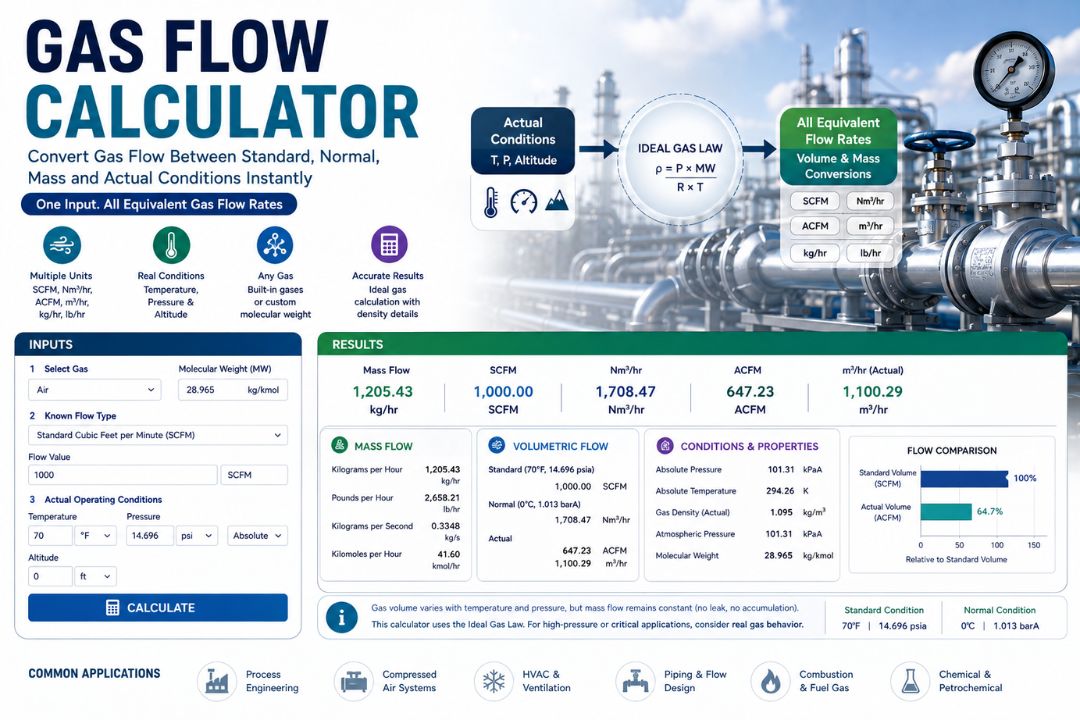
Gas Flow Calculator
Convert gas flow between standard volume, normal volume, mass flow and actual volumetric flow at your operating temperature and pressure.
1. Select Gas
Choose a common gas or enter a custom molecular weight.
2. Enter Known Flow
Select the type of gas flow measurement you already know.
3. Actual Operating Conditions
Enter the temperature and pressure where the actual volumetric flow exists.
Standard & Normal Volume Flow
Gas volume referenced to defined standard conditions.
Mass Flow
Gas mass passing through the system per unit time.
Actual Volumetric Flow
Gas volume at the entered operating temperature and pressure.
Gas Flow Conversion Summary
Equivalent flow values calculated from the same mass flow.
| Flow Measurement | Result |
|---|---|
| Standard Cubic Feet / Minute | — |
| Normal Cubic Metres / Hour | — |
| Pounds / Hour | — |
| Kilograms / Hour | — |
| Actual Cubic Feet / Minute | — |
| Actual Cubic Metres / Hour | — |
Ideal Gas Density: ρ = P × MW ÷ (R × T)
Mass Flow: ṁ = ρ × Q
Actual Volume Flow: Q = ṁ ÷ ρ
P must be absolute pressure and T must be absolute temperature.
Gas Flow Calculator: Convert SCFM, Nm³/hr, Mass Flow and Actual Gas Volume
Gas flow calculations are important in engineering, manufacturing, HVAC, compressed air systems, chemical processing, combustion, ventilation, piping design, and many other technical applications. However, gas flow can be expressed in several different ways depending on the system, measurement standard, and operating conditions. A flow rate may be given as SCFM, Nm³/hr, kg/hr, lb/hr, ACFM, or actual m³/hr, and these values cannot always be converted using a simple fixed conversion factor because gas volume changes with temperature and pressure.
The Gas Flow Calculator on CalQenix is designed to make these conversions easier. It allows you to enter one known gas flow value, choose the gas or molecular weight, specify actual temperature and pressure, and calculate equivalent standard, normal, mass, and actual volumetric flow rates.
This makes the calculator useful for engineers, technicians, students, plant operators, HVAC professionals, process designers, and anyone who needs to compare gas flow measurements under different conditions.
What Is a Gas Flow Calculator?
A Gas Flow Calculator is a tool used to convert gas flow rates from one measurement basis to another.
Unlike liquids, gases are highly compressible.
The volume occupied by a given mass of gas changes when temperature or pressure changes.
For example, one kilogram of air does not occupy the same volume at high pressure as it does at atmospheric pressure.
Similarly, hot gas generally occupies more volume than the same mass of gas at a lower temperature when pressure remains constant.
This means that an actual volumetric flow such as ACFM cannot always be directly compared with a standard volumetric flow such as SCFM.
A proper gas flow calculation needs to consider temperature, absolute pressure, molecular weight, and the reference conditions used for standard or normal volume.
What Can the CalQenix Gas Flow Calculator Convert?
The calculator can convert between several commonly used gas flow units.
These include:
Standard Cubic Feet per Minute, or SCFM
Normal Cubic Metres per Hour, or Nm³/hr
Pounds per Hour, or lb/hr
Kilograms per Hour, or kg/hr
Actual Cubic Feet per Minute, or ACFM
Actual Cubic Metres per Hour, or m³/hr
The calculator also provides useful additional values such as gas density, molar flow, absolute pressure, absolute temperature, and local atmospheric pressure.
This allows you to see not only the converted flow rate but also the conditions influencing the result.
What Is SCFM?
SCFM stands for Standard Cubic Feet per Minute.
It represents a gas flow rate expressed as the equivalent volume the gas would occupy under specified standard reference conditions.
SCFM is commonly used in compressed air systems, ventilation equipment, blowers, compressors, process equipment, and industrial gas applications.
The word “standard” is important.
SCFM does not necessarily mean that the gas is physically flowing at standard temperature and pressure.
Instead, it expresses the mass flow as an equivalent volume at the standard reference condition.
This makes it easier to compare gas flows measured under different operating conditions.
What Is Nm³/hr?
Nm³/hr means Normal Cubic Metres per Hour.
Like SCFM, this is a reference-condition volumetric flow.
The “N” indicates that the gas volume has been normalized to defined normal temperature and pressure conditions.
Normal cubic metres are widely used in metric engineering applications, gas supply systems, process industries, and international technical documentation.
Because normal and standard conditions may use different reference temperatures, an SCFM value should not be converted to Nm³/hr using only the ordinary cubic-foot-to-cubic-metre conversion.
The difference in reference temperature and pressure also needs to be considered.
The CalQenix calculator handles this automatically.
Standard Conditions vs Normal Conditions
Gas flow calculations often use terms such as standard and normal conditions.
These terms are not always identical.
In the calculator, standard flow is referenced to 70°F and 14.696 psia.
Normal flow is referenced to 0°C and approximately 1.013 bar absolute.
Because the standard temperature is warmer than the normal temperature, the same mass of gas occupies different reference volumes under the two conditions.
This explains why the numerical SCFM and Nm³/hr values do not simply differ by the physical conversion between cubic feet and cubic metres.
The reference conditions must always be known when performing precise gas flow conversions.
What Is Actual Gas Flow?
Actual volumetric flow represents the physical gas volume flowing through the system at the actual operating temperature and pressure.
Common actual volume measurements include:
ACFM, or Actual Cubic Feet per Minute
Actual m³/hr, or Actual Cubic Metres per Hour
Suppose a compressor delivers gas at elevated pressure.
The same mass of gas occupies a smaller physical volume at the higher pressure.
If that gas later expands to atmospheric pressure, its volume increases.
This means the ACFM at one pressure may differ greatly from the equivalent SCFM even though the mass flow remains the same.
What Is Mass Flow?
Mass flow measures the actual amount of gas mass moving through a system over time.
Common units include:
kg/hr
kg/s
lb/hr
Unlike volumetric flow, mass flow does not depend directly on the space occupied by the gas.
If there are no leaks or accumulation, the same mass entering a pipe system must leave the system, even if pressure and temperature change along the way.
This makes mass flow an important common basis for converting between standard, normal, and actual gas volumes.
The Gas Flow Calculator first converts the entered flow into an equivalent mass flow and then uses that mass flow to calculate the other flow values.
Why Temperature Matters in Gas Flow
Temperature strongly affects gas volume.
When gas temperature increases while pressure remains constant, the gas expands.
When temperature decreases, the gas contracts.
This relationship means a hot gas stream may have a much higher actual volumetric flow than the same mass flow at a lower temperature.
For gas calculations, temperature must be converted to an absolute temperature scale.
The calculator supports Fahrenheit, Celsius, and Kelvin, but internally converts the entered value to Kelvin before performing the gas law calculation.
Using Celsius or Fahrenheit directly in an ideal gas equation would produce incorrect results because those scales do not begin at absolute zero.
Why Pressure Matters in Gas Flow
Pressure also has a major influence on gas volume.
Higher pressure compresses gas into a smaller volume.
Lower pressure allows the gas to occupy a larger volume.
This is why compressed air systems can transport a large quantity of air mass through relatively small pipes while the air is pressurized.
When comparing actual flow with standard flow, the calculator must know the absolute pressure of the gas.
The pressure value therefore needs to be correctly identified as either absolute pressure or gauge pressure.
Gauge Pressure vs Absolute Pressure
Gauge pressure measures pressure relative to the surrounding atmosphere.
Absolute pressure measures pressure relative to a perfect vacuum.
A pressure gauge reading of 0 psi does not mean there is no pressure.
It means the pressure is equal to the surrounding atmospheric pressure.
At sea level, atmospheric pressure is approximately 14.7 psi absolute.
Therefore:
Absolute Pressure = Gauge Pressure + Atmospheric Pressure
The Gas Flow Calculator allows you to select either gauge or absolute pressure.
If gauge pressure is selected, the calculator estimates local atmospheric pressure based on altitude and adds it to the gauge reading.
This produces the absolute pressure needed for gas flow calculations.
Why Altitude Matters
Atmospheric pressure decreases as altitude increases.
A location at sea level has higher atmospheric pressure than a location high in the mountains.
This matters when gauge pressure is used.
For example, a gas system operating at 5 psi gauge at sea level does not have exactly the same absolute pressure as a system operating at 5 psi gauge at a high-altitude site.
The calculator includes an altitude input so it can estimate local atmospheric pressure.
You can enter altitude in feet or metres.
This makes the gauge-to-absolute pressure conversion more realistic.
What Is Molecular Weight?
Molecular weight is one of the key properties used in gas density calculations.
Different gases have different molecular weights.
For example, hydrogen is extremely light, while gases such as carbon dioxide and propane are much heavier.
At the same temperature and pressure, a gas with a higher molecular weight generally has a higher density.
This means the same actual volumetric flow can represent very different mass flow rates depending on the gas.
The calculator includes common gases such as air, nitrogen, oxygen, carbon dioxide, methane, hydrogen, helium, argon, and propane.
You can also enter a custom molecular weight for another gas or gas mixture.
Gas Density Formula
The calculator uses an ideal gas relationship to estimate density.
The general equation is:
ρ = P × MW ÷ (R × T)
Where:
ρ is gas density
P is absolute pressure
MW is molecular weight
R is the universal gas constant
T is absolute temperature
Once density is known, mass flow can be determined from volumetric flow.
Mass Flow = Density × Volumetric Flow
The same relationship can be rearranged to calculate actual volume from mass flow.
Volumetric Flow = Mass Flow ÷ Density
These relationships form the basis of the calculator.
Example of Gas Flow Conversion
Suppose you know that air is flowing at 1,000 SCFM.
You select Air from the gas list.
The calculator uses the molecular weight of air and determines the mass flow represented by 1,000 SCFM at the standard reference condition.
It then uses that same mass flow to calculate the equivalent Nm³/hr.
If you also enter an actual gas temperature and pressure, it calculates the actual density and determines the corresponding ACFM and m³/hr.
The important point is that all of the results represent the same mass of gas flowing through the system.
Only the volume basis changes.
Why SCFM and ACFM Can Be Very Different
Consider compressed gas at a high pressure.
At high pressure, gas density increases.
A relatively small actual volume can therefore contain a large amount of gas mass.
When that same mass is converted to standard conditions, it expands to a much larger standard volume.
This means a compressed air system might have an actual flow of only a few hundred ACFM while representing a much larger SCFM value.
At low pressure or high temperature, the opposite effect can occur.
The actual volume may become greater than the standard volume.
The calculator includes a visual comparison so you can see how actual and standard volumes differ.
Gas Flow in Compressed Air Systems
Compressed air systems frequently use SCFM because equipment capacity is often expressed in standard airflow.
A compressor may be rated for a specific SCFM, while piping velocities and pressure drops depend on actual volumetric flow inside the compressed air line.
This creates an important distinction.
SCFM helps describe how much air mass the compressor provides.
ACFM helps describe how much physical volume moves through the pipe at the operating pressure.
Both measurements can be useful for different engineering calculations.
Gas Flow in HVAC Systems
HVAC systems often deal with large air volumes.
Ventilation and air-handling calculations may use actual cubic feet per minute because the air moves through ducts at local operating conditions.
However, industrial ventilation, combustion air, or specialized process systems may require conversion between standard and actual flow.
Temperature changes can also affect air density.
This means gas flow conversion can be useful when evaluating fans, ducts, heat exchangers, and ventilation equipment.
Gas Flow in Chemical and Process Engineering
Chemical plants often handle gases at temperatures and pressures very different from atmospheric conditions.
For example, a process gas may be heated to several hundred degrees while operating at elevated pressure.
A standard volumetric flow alone does not describe the physical volume moving through the process pipe.
Engineers may therefore convert between normal volume, actual volume, and mass flow depending on the equipment being designed.
Mass flow is especially useful for material balances, while actual volume is important for pipe velocity and equipment sizing.
Why Mass Flow Is Useful for Material Balances
Material balances are based on conservation of mass.
If a steady process has no leaks, accumulation, or chemical generation of a particular component, the mass entering must equal the mass leaving.
Volumetric flow may change as pressure or temperature changes, but mass flow remains consistent.
For this reason, converting a volumetric gas flow into kg/hr or lb/hr can make process calculations easier.
The CalQenix calculator provides mass flow directly alongside standard and actual volumetric flow.
What Is Molar Flow?
Molar flow expresses gas quantity in terms of the number of kilomoles passing through the system per hour.
The relationship is:
Molar Flow = Mass Flow ÷ Molecular Weight
Molar flow is often useful in chemical calculations because chemical reactions are based on the number of molecules or moles rather than simply mass.
For example, combustion calculations may compare the molar quantities of fuel and oxygen.
The calculator includes kmol/hr as an additional engineering output.
Can I Use the Calculator for Gas Mixtures?
Yes, if you know the average molecular weight of the mixture.
Select the custom gas option and enter the molecular weight manually.
For a mixture, molecular weight can be calculated from the composition of the gas.
However, complex gas mixtures may show non-ideal behaviour under certain conditions.
For high-accuracy engineering work, additional thermodynamic properties may be needed.
What Is the Ideal Gas Assumption?
The calculator uses the ideal gas equation.
The ideal gas model assumes that gas molecules behave according to a simplified relationship between pressure, volume, temperature, and amount of gas.
This approximation works reasonably well for many gases at moderate pressures and temperatures away from condensation conditions.
However, real gases do not always behave perfectly ideally.
At very high pressure or very low temperature, the difference can become significant.
What Is a Compressibility Factor?
A compressibility factor, commonly written as Z, is used to correct the ideal gas equation for real-gas behaviour.
For an ideal gas:
Z = 1
For a real gas, Z may be higher or lower than 1 depending on pressure, temperature, and composition.
A more advanced gas-flow calculation may use:
PV = Z nRT
The CalQenix calculator uses Z = 1, meaning ideal-gas behaviour is assumed.
For routine estimates this can be useful, but precision process design may require a real-gas equation of state.
Why Pressure Must Be Absolute
One of the most common mistakes in gas calculations is using gauge pressure directly in the ideal gas equation.
The gas law requires absolute pressure.
For example, 50 psi gauge is not the same as 50 psi absolute.
At sea level, 50 psi gauge is approximately 64.7 psi absolute.
Using 50 instead of 64.7 would produce an incorrect density and therefore incorrect flow conversions.
The calculator prevents this problem by converting gauge pressure to absolute pressure internally.
Why Temperature Must Be Absolute
The same principle applies to temperature.
The gas law cannot use ordinary Celsius or Fahrenheit values directly.
For example, 20°C cannot be treated as the number 20 in the equation.
It must be converted to approximately 293.15 K.
Similarly, 68°F must be converted to an absolute temperature before calculating density.
The calculator performs this conversion automatically.
Common Gas Flow Calculation Mistakes
A common mistake is treating SCFM and ACFM as though they are identical.
Another is forgetting that standard and normal conditions use different references.
Using gauge pressure instead of absolute pressure is also a frequent error.
Temperature conversion is another potential problem.
A gas law calculation using Celsius rather than Kelvin can produce meaningless results.
Users may also select the wrong molecular weight, which changes the calculated gas density and mass flow.
The CalQenix tool is designed to reduce these common conversion errors by handling the required unit conversions internally.
Can the Calculator Be Used for High-Pressure Gas?
It can provide an ideal-gas estimate, but caution is required.
At higher pressures, many gases deviate increasingly from ideal behaviour.
A compressibility factor or more advanced thermodynamic equation may be necessary.
If the result is being used for safety-critical design, pressure vessel sizing, custody transfer, regulatory calculations, or high-value process engineering, appropriate engineering standards and verified property data should be used.
Is the Gas Flow Calculator Accurate?
The mathematical calculation is accurate under the assumptions used by the tool.
Those assumptions include ideal gas behaviour, correct molecular weight, correct temperature, correct absolute pressure, and the stated standard and normal reference conditions.
The quality of the result therefore depends strongly on the accuracy of the input data.
Instrument error, gas composition uncertainty, non-ideal behaviour, moisture content, and compressibility effects may cause actual plant values to differ.
Frequently Asked Questions
What is the difference between SCFM and CFM?
SCFM refers to gas volume corrected to standard reference conditions, while actual CFM represents physical gas volume at operating conditions.
What is the difference between SCFM and Nm³/hr?
Both represent reference-condition gas flow, but they use different units and reference conditions.
Does gas flow change with pressure?
Actual volumetric flow changes with pressure, while mass flow remains constant if no gas is added, removed, or accumulated.
Does temperature affect gas flow?
Yes. Gas volume generally increases as temperature rises at constant pressure.
Can I convert kg/hr to SCFM?
Yes. Enter kg/hr as the known flow, choose the gas, and the calculator will determine equivalent SCFM.
Can I convert SCFM to ACFM?
Yes. Enter SCFM, then specify actual temperature and pressure. The calculator will determine actual CFM.
Why do I need molecular weight?
Molecular weight is needed to calculate gas density and convert between mass flow and volume flow.
Can I enter gauge pressure?
Yes. Select Gauge and enter site altitude so the calculator can estimate local atmospheric pressure and convert the value to absolute pressure.
Final Thoughts
The Gas Flow Calculator provides a practical way to convert between the most common gas flow measurements without manually performing multiple pressure, temperature, density, and unit conversions.
You can begin with SCFM, Nm³/hr, kg/hr, lb/hr, ACFM, or actual m³/hr and calculate all corresponding flow values from the same gas mass flow.
The calculator also shows important supporting values such as molecular weight, gas density, absolute temperature, absolute pressure, atmospheric pressure, and molar flow.
These outputs can make it easier to understand why gas volumes change under different operating conditions.
The most important principle is that gas volume depends on temperature and pressure.
A value such as 1,000 cubic feet per minute is incomplete unless you know whether that volume refers to standard conditions or the actual operating environment.
Mass flow provides a useful common basis for converting between these different volumetric measurements.
Use the CalQenix Gas Flow Calculator for engineering estimates, equipment comparisons, compressed air calculations, HVAC work, process studies, and general gas-flow conversions.
For applications involving high pressure, non-ideal gases, phase change, or safety-critical design, use appropriate engineering standards and real-gas property methods in addition to the calculator.
