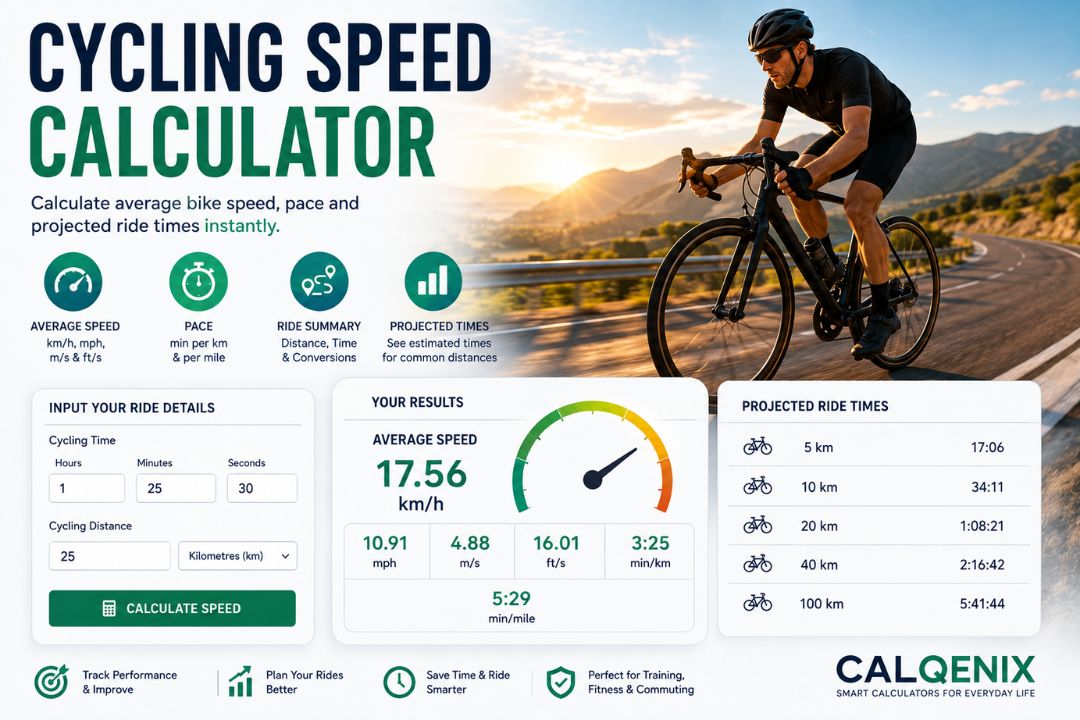
Cycling Speed Calculator
Enter your cycling distance and ride time to calculate average speed, cycling pace and projected ride times.
Speed
Your average cycling speed in common units.
Cycling Pace
Average time required to cover one kilometre or mile.
Projected Ride Times
Estimated finish times if you maintain the same average speed.
Cycling Speed Conversion
Quick comparison between metric and imperial speed.
| Measurement | Result |
|---|---|
| Metres per second | 0.00 m/s |
| Feet per second | 0.00 ft/s |
| Kilometres per hour | 0.00 km/h |
| Miles per hour | 0.00 mph |
| Minutes per kilometre | 0:00 min/km |
| Minutes per mile | 0:00 min/mi |
Average Speed = Total Distance ÷ Total Time
km/h = metres per second × 3.6
mph = metres per second × 2.23694
Cycling Pace = Time ÷ Distance
Cycling Speed Calculator: Calculate Average Bike Speed, Pace and Ride Times
Cycling is one of the most popular forms of exercise, transport, recreation, and competitive sport. Whether you ride a road bike, mountain bike, hybrid bike, gravel bike, or electric bike, understanding your average cycling speed can help you track progress, compare rides, set realistic goals, and plan future journeys. The Cycling Speed Calculator on CalQenix is designed to make this process quick and simple.
Instead of manually converting hours, minutes, seconds, kilometres, miles, metres, or feet, you can enter your total ride time and distance and allow the calculator to determine your average speed automatically. The calculator can show results in kilometres per hour, miles per hour, metres per second, and feet per second. It can also calculate cycling pace per kilometre and per mile and estimate how long common cycling distances could take if you maintain the same average speed.
This makes the tool useful for beginners, recreational cyclists, commuters, endurance riders, triathletes, and competitive cyclists who want an easy way to analyse riding performance.
What Is a Cycling Speed Calculator?
A Cycling Speed Calculator is an online tool that determines your average cycling speed based on the distance travelled and the time taken to cover that distance.
The basic idea is simple:
Average Speed = Distance ÷ Time
For example, if you cycle 20 kilometres in one hour, your average cycling speed is 20 kilometres per hour.
If you ride the same 20 kilometres in 40 minutes, your average speed will be higher because you covered the same distance in less time.
The calculator performs this calculation automatically and then converts the result into different speed and pace units.
How to Use the Cycling Speed Calculator
Using the CalQenix Cycling Speed Calculator is straightforward.
Start by entering your cycling time.
The calculator provides separate fields for hours, minutes, and seconds.
If your ride took 1 hour, 25 minutes, and 30 seconds, you can enter those values directly without converting the entire duration into decimal hours.
Next, enter your cycling distance.
You can select the appropriate distance unit, including kilometres, metres, miles, or feet.
Once the values are entered, select Calculate Cycling Speed.
The calculator will display your average speed and additional cycling metrics.
Cycling Speed Formula
The main formula used by the calculator is:
Average Speed = Total Distance ÷ Total Time
However, both distance and time need to be expressed in compatible units.
Suppose you cycle 30 kilometres in 1 hour and 30 minutes.
One hour and 30 minutes equals 1.5 hours.
The calculation becomes:
30 ÷ 1.5 = 20
Your average cycling speed is therefore:
20 km/h
The calculator handles these conversions automatically, reducing the risk of mistakes when time includes both hours and minutes.
Example of Cycling Speed Calculation
Imagine you ride 25 kilometres in exactly one hour.
Your average speed is:
25 ÷ 1 = 25 km/h
This is approximately 15.53 miles per hour.
If you travel the same 25 kilometres in 50 minutes, your average speed will increase.
Fifty minutes equals approximately 0.8333 hours.
The calculation is:
25 ÷ 0.8333 = approximately 30 km/h
This demonstrates how average speed increases when the same distance is covered in less time.
What Does Average Cycling Speed Mean?
Average cycling speed represents the overall distance travelled divided by the total time entered.
It does not necessarily mean that you rode at exactly that speed throughout the ride.
For example, your bike computer might show speeds ranging from 10 km/h while climbing a steep hill to 45 km/h while descending.
If the complete ride averages 24 km/h, then 24 km/h is your average speed.
Average speed provides a simple way to summarise an entire cycling session.
Average Speed vs Maximum Speed
Average cycling speed and maximum cycling speed are different measurements.
Average speed considers the entire ride.
Maximum speed is the highest speed reached at any point.
A cyclist may have an average speed of 22 km/h but reach a maximum speed of 50 km/h during a downhill section.
Maximum speed can be interesting, but average speed is usually more useful when comparing overall performance between rides.
Kilometres per Hour
Kilometres per hour, abbreviated as km/h, is one of the most common cycling speed measurements.
If you travel 25 kilometres in one hour, your speed is 25 km/h.
If you travel 50 kilometres in two hours, your speed is also 25 km/h.
Many cycling computers, fitness apps, GPS devices, and training platforms use kilometres per hour in countries that follow the metric system.
The CalQenix calculator automatically converts your result into km/h regardless of which distance unit you originally enter.
Miles per Hour
Miles per hour, abbreviated mph, is commonly used in countries where imperial units are popular.
The calculator converts metric speed to miles per hour automatically.
One kilometre is approximately 0.621371 miles.
Therefore, a cycling speed of 20 km/h is approximately:
12.43 mph
A speed of 30 km/h is approximately:
18.64 mph
A speed of 40 km/h is approximately:
24.85 mph
Having both km/h and mph results makes it easier to compare rides, training plans, and cycling information from different countries.
Metres per Second
Metres per second, abbreviated m/s, is a standard scientific unit of speed.
Although cyclists do not commonly use metres per second during everyday rides, it is useful for technical calculations and speed conversions.
The relationship between metres per second and kilometres per hour is:
km/h = m/s × 3.6
For example, a speed of 5 metres per second equals:
5 × 3.6 = 18 km/h
The calculator includes this value automatically.
Feet per Second
Feet per second is another possible way to express cycling speed.
This measurement may be useful in engineering, technical analysis, or certain imperial calculations.
One metre per second is approximately 3.28084 feet per second.
The CalQenix calculator includes ft/s so users can quickly compare speed across several measurement systems.
What Is Cycling Pace?
Cycling pace measures how much time it takes to cover a specific distance.
This is the opposite perspective from speed.
Speed tells you how far you travel in a certain amount of time.
Pace tells you how much time you need to cover a certain distance.
For example, if you ride at 20 km/h, you cover one kilometre in approximately 3 minutes.
Your cycling pace would therefore be around:
3:00 min/km
Pace is more commonly discussed in running, but it can also be useful in cycling, especially when planning routes and estimating finish times.
Cycling Pace per Kilometre
Pace per kilometre represents the amount of time required to cycle one kilometre at your average speed.
For example, if your average cycling speed is 30 km/h, you cover 30 kilometres in 60 minutes.
Therefore:
60 ÷ 30 = 2 minutes per kilometre
Your cycling pace is:
2:00 min/km
At 20 km/h, your pace is:
3:00 min/km
At 15 km/h, your pace is:
4:00 min/km
The calculator automatically converts your average speed into pace.
Cycling Pace per Mile
Cycling pace per mile shows how much time you need to cover one mile.
Suppose your average speed is 15 miles per hour.
You travel 15 miles in 60 minutes.
Therefore:
60 ÷ 15 = 4 minutes per mile
Your pace is approximately:
4:00 min/mi
This can be helpful when planning cycling routes measured in miles.
Why Track Cycling Speed?
Tracking cycling speed can provide valuable feedback about your fitness and performance.
If you regularly ride the same route, average speed gives you a simple way to compare rides.
For example, you might complete a 20-kilometre route at an average speed of 21 km/h during your first month of training.
Several weeks later, you may complete the same route at 24 km/h under similar conditions.
That improvement can indicate better fitness, pacing, technique, or cycling efficiency.
However, speed should always be considered together with route conditions.
Factors That Affect Cycling Speed
Cycling speed can vary significantly even when your fitness level remains unchanged.
One major factor is terrain.
Cycling uphill naturally reduces speed, while downhill sections can increase speed significantly.
Wind also has a major effect.
A strong headwind can slow a cyclist considerably, while a tailwind can increase average speed.
Road surface matters as well.
Smooth asphalt usually allows faster riding than loose gravel or rough trails.
Traffic, intersections, weather, bike type, tyre pressure, rider weight, aerodynamic position, fitness, and fatigue can all affect cycling speed.
For this reason, comparing average speed between completely different rides may not always provide a fair performance comparison.
Does Bike Type Affect Speed?
Yes.
Different bicycles are designed for different purposes.
Road bikes are generally built for efficiency and speed on paved surfaces.
They often have lightweight frames, narrow tyres, and aerodynamic riding positions.
Mountain bikes are designed for control and durability on rough terrain.
Their wider tyres, suspension, and upright riding positions can create more rolling and aerodynamic resistance on roads.
Gravel bikes provide a compromise between road speed and off-road capability.
Hybrid bikes are often designed for comfort and everyday riding.
Because of these differences, two riders with similar fitness levels may produce different average speeds on different bicycles.
Average Cycling Speed for Beginners
There is no single speed that every beginner should aim for.
Cycling speed depends on terrain, bike type, fitness, weather, distance, and experience.
A beginner may ride comfortably at a moderate pace and gradually increase speed as fitness improves.
Rather than comparing yourself with experienced cyclists, it is often more useful to compare your current rides with your own previous performance.
If you improve from 15 km/h to 17 km/h on the same route with similar conditions, that is meaningful progress.
Cycling Speed for Long-Distance Rides
Average speed often decreases as ride distance increases.
A cyclist may maintain a relatively high speed during a short 10-kilometre ride but need a more sustainable pace during a 100-kilometre ride.
Long-distance cycling requires energy management, hydration, nutrition, pacing, and muscular endurance.
The Cycling Speed Calculator can estimate projected times for longer distances, but it assumes the same average speed can be maintained.
In reality, fatigue may make longer rides slower.
Projected Cycling Times
The calculator can estimate how long common distances may take if you maintain your current average speed.
Suppose your average speed is 25 km/h.
A 5-kilometre ride would take approximately:
12 minutes
A 10-kilometre ride would take approximately:
24 minutes
A 20-kilometre ride would take approximately:
48 minutes
A 40-kilometre ride would take approximately:
1 hour 36 minutes
A 100-kilometre ride would take approximately:
4 hours
These projections are mathematical estimates and do not account for fatigue, stops, traffic, climbs, or changing conditions.
Using the Calculator for Commuting
A Cycling Speed Calculator can be useful for planning a bike commute.
Suppose your workplace is 12 kilometres away.
If your usual average speed is 18 km/h, the calculator can help estimate your typical travel time.
Knowing this information can help you plan when to leave home.
However, commuting times may be affected by traffic lights, crossings, road congestion, and stops.
If your entered ride time includes these stops, the calculator calculates an overall journey average.
Moving Time vs Elapsed Time
Cycling apps often distinguish between moving time and elapsed time.
Moving time includes only the periods when the bicycle is actually moving.
Elapsed time includes stops.
Suppose your total journey takes 2 hours, but you stop for 20 minutes.
Your moving time is 1 hour and 40 minutes.
If average speed is calculated using moving time, the result will be higher than if the full elapsed time is used.
The CalQenix calculator uses whatever time you enter.
Therefore, decide whether you want to calculate moving average speed or overall journey average speed before entering the time.
Cycling Speed for Training
Average speed can be useful as one part of a cycling training plan.
For example, you might use a familiar flat route as a benchmark.
Record the distance and time, then calculate your average speed.
Repeat the ride several weeks later under similar conditions.
If your speed increases while effort feels similar, your cycling fitness may have improved.
However, serious cycling training often uses additional measurements such as heart rate, power output, cadence, and perceived effort.
Speed alone does not tell the complete story.
What Is Cadence?
Cadence refers to how quickly a cyclist pedals, usually measured in revolutions per minute.
Cadence is different from speed.
Two cyclists can travel at the same speed while using different gears and cadences.
One may pedal quickly in a lower gear, while another pedals more slowly in a higher gear.
The Cycling Speed Calculator does not calculate cadence because cadence requires pedal revolution information rather than only distance and time.
Speed vs Cycling Power
Cycling power measures how much mechanical work a rider produces, usually in watts.
Power is often considered a more reliable training metric than speed because speed is strongly affected by external conditions such as wind and hills.
For example, you may produce high power while climbing but travel slowly.
On a downhill section, you may travel very quickly while producing little power.
The Cycling Speed Calculator measures average travel speed rather than cycling power.
Can I Use the Calculator for Indoor Cycling?
Yes, if your indoor bike or trainer provides an estimated distance.
Enter the distance and total cycling time into the calculator.
However, indoor cycling distance can be estimated differently by different machines and platforms.
Because there is no real movement over a road, indoor distance is often based on virtual or mechanical calculations.
Use the results mainly for comparing sessions using the same equipment or platform.
Can I Use It for Mountain Biking?
Yes.
The mathematical calculation works for any cycling activity where distance and time are known.
However, mountain biking speeds are often lower than road cycling speeds because trails may include steep climbs, loose surfaces, rocks, technical sections, and sharp turns.
A lower average speed does not necessarily mean lower fitness.
Terrain difficulty must be considered.
Can I Use It for an E-Bike?
Yes.
You can calculate the average speed of an electric bicycle using the same distance and time formula.
Keep in mind that legal e-bike assistance limits vary by country and region, and local rules may restrict motor assistance above certain speeds.
The calculator does not determine legal compliance. It only calculates average speed from the information entered.
How to Improve Average Cycling Speed
Improving cycling speed generally requires a combination of fitness, technique, equipment, and pacing.
Regular riding can improve cardiovascular endurance.
Interval training can help develop higher-intensity performance.
Long steady rides can improve endurance.
Strength training may improve muscular power.
Aerodynamic positioning can reduce air resistance.
Proper tyre pressure and bike maintenance can reduce unnecessary rolling resistance.
Good pacing is also important.
Starting too aggressively may cause fatigue and reduce speed later in the ride.
Aerodynamics and Cycling Speed
Air resistance becomes increasingly important as cycling speed rises.
At higher speeds, a large amount of cycling effort is used to overcome aerodynamic drag.
This is why road cyclists often use lower riding positions, fitted clothing, aerodynamic helmets, and streamlined equipment.
A small change in body position may have a noticeable effect on speed, especially during fast rides.
However, comfort and safety should always remain important.
Hills and Average Speed
Hills can significantly reduce average speed.
A cyclist may climb at 10 km/h and descend at 40 km/h, but the slower uphill section usually takes longer.
Because you spend more time climbing slowly than descending quickly, hilly routes often have lower overall average speeds.
This is one reason it is best to compare speed between similar routes.
Wind and Cycling Performance
Wind can dramatically affect cycling speed.
A strong headwind increases aerodynamic resistance and may reduce speed even when effort remains high.
A tailwind can make the same cyclist significantly faster.
Crosswinds may also affect handling.
If you use average speed as a training benchmark, try to consider wind conditions when comparing rides.
Why Projected Ride Times May Be Different From Reality
Projected ride times assume that you can maintain the same average speed over another distance.
This is not always realistic.
A cyclist who averages 35 km/h during a 10-kilometre effort may not maintain 35 km/h over 100 kilometres.
Long rides introduce fatigue, nutrition requirements, rest stops, elevation changes, and other variables.
Projected times are best used as simple planning estimates.
Common Cycling Speed Calculation Mistakes
One common mistake is using minutes as though they were decimal hours.
For example, 1 hour 30 minutes is 1.5 hours, not 1.30 hours.
Another mistake is mixing kilometres and miles.
A 20-mile ride is considerably longer than a 20-kilometre ride.
Some cyclists also compare average speeds without considering whether one result uses moving time and another uses total elapsed time.
The CalQenix calculator reduces unit-conversion errors by allowing time and distance units to be entered separately.
Is the Cycling Speed Calculator Accurate?
The mathematical calculation is accurate when the distance and time entered are correct.
Average speed is simply a relationship between these two values.
However, the calculator does not measure the accuracy of your GPS device, bike computer, indoor trainer, or distance estimate.
If the original distance or time measurement is incorrect, the calculated speed will also be affected.
Projected ride times should also be treated as estimates rather than guaranteed results.
Frequently Asked Questions
How do I calculate cycling speed?
Divide the total cycling distance by the total ride time.
What is the formula for average bike speed?
Average Speed = Distance ÷ Time.
Can I calculate cycling speed in mph?
Yes. The calculator automatically displays your result in miles per hour.
Can I use kilometres?
Yes. You can enter cycling distance in kilometres, metres, miles, or feet.
Does the calculator show pace?
Yes. It calculates average cycling pace per kilometre and per mile.
Can I calculate projected cycling times?
Yes. The calculator estimates times for common distances if you maintain the same average speed.
Does stopping affect average speed?
If your entered time includes stops, the result will include those stops. For moving average speed, enter only your actual moving time.
Is average speed a good measure of cycling fitness?
It can be useful, especially when comparing similar routes and conditions, but wind, terrain, traffic, equipment, and other factors can significantly affect speed.
Final Thoughts
The Cycling Speed Calculator is a practical way to turn cycling distance and time into useful performance information.
With only a few inputs, you can calculate average speed in kilometres per hour, miles per hour, metres per second, and feet per second.
You can also see cycling pace per kilometre and mile, compare metric and imperial measurements, and estimate how long other ride distances could take.
These calculations can be useful for commuting, recreational cycling, training, endurance riding, route planning, and general performance tracking.
The most important thing to remember is that average speed should always be interpreted in context.
A slower ride on a steep, windy route may represent a stronger physical effort than a faster ride on a flat road with a tailwind.
Bike type, road surface, traffic, temperature, fatigue, stops, and fitness can all influence cycling speed.
Use the CalQenix Cycling Speed Calculator as a simple way to understand your ride data, compare similar cycling sessions, set realistic targets, and plan future distances more confidently.
