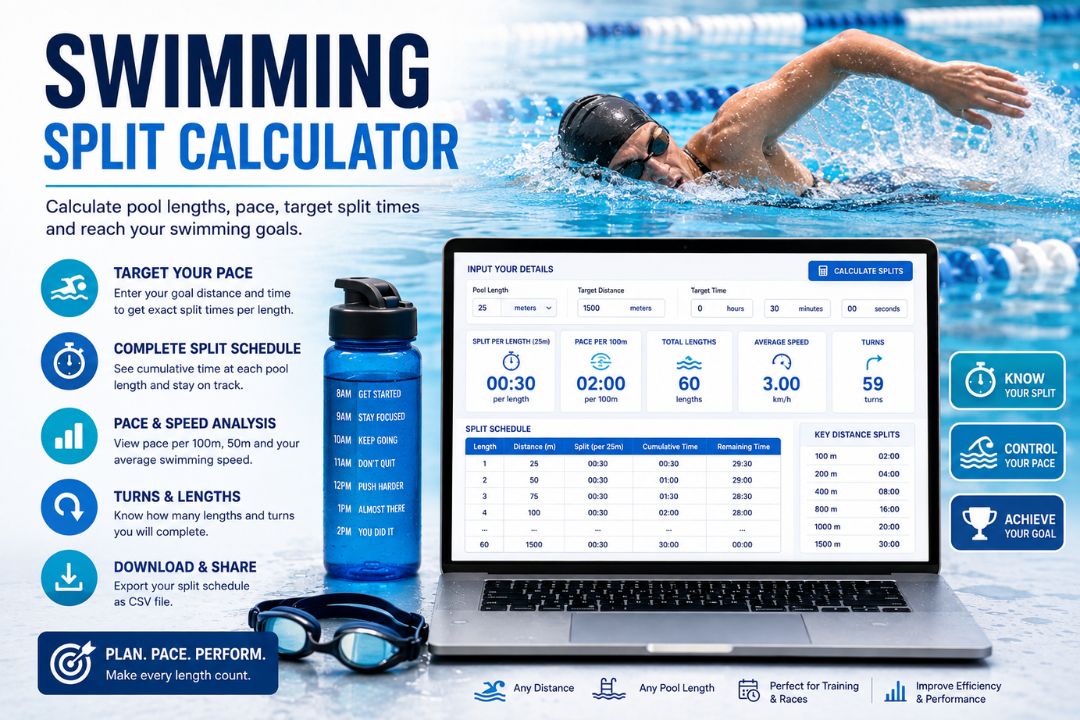
Swimming Split Calculator
Calculate your target pool split times, pace, number of lengths and average swimming speed for any distance and finish time.
Swimming Split Schedule
Target cumulative time at each pool length.
| Length | Distance | Length Split | Cumulative Time | Remaining |
|---|
Key Distance Splits
Useful checkpoints at your target pace.
Time per Pool Length = Total Target Time ÷ Number of Pool Lengths
Number of Lengths = Target Distance ÷ Pool Length
Pace per 100 = Total Time ÷ Distance × 100
Swimming Split Calculator: Calculate Pool Lengths, Pace and Target Split Times
Swimming performance becomes much easier to understand when you know exactly what pace you need to hold from one pool length to the next. A swimmer may know that they want to complete 1,500 metres in 30 minutes, but that goal is much more useful when it is converted into practical split times such as 30 seconds per 25 metres, 1 minute per 50 metres, or 2 minutes per 100 metres. The Swimming Split Calculator on CalQenix is designed to make these calculations quick and easy.
The calculator allows you to enter your pool length, target swimming distance, and desired finish time. It then calculates how many pool lengths you need to complete, your target split per length, your pace per 50 and 100 metres or yards, your average swimming speed, the number of turns, and a complete split schedule.
This makes the calculator useful for swimmers who want to train more consistently, prepare for competitions, estimate triathlon swim pacing, or simply understand how fast they need to swim to achieve a particular goal.
What Is a Swimming Split Calculator?
A Swimming Split Calculator is a tool that converts a target swimming distance and finish time into smaller, easier-to-follow checkpoints.
Instead of thinking only about the total swim, the calculator breaks the target into individual pool lengths and cumulative split times.
For example, suppose your goal is to swim 1,000 metres in 20 minutes in a 25-metre pool.
The calculator can determine that 1,000 metres equals 40 pool lengths.
It can also calculate that you need to average approximately 30 seconds per 25-metre length.
That means your stopwatch should show approximately:
30 seconds after 25 metres
1:00 after 50 metres
2:00 after 100 metres
10:00 after 500 metres
20:00 after 1,000 metres
These checkpoints make it easier to control your pace throughout the swim.
How to Use the Swimming Split Calculator
Using the CalQenix Swimming Split Calculator is straightforward.
First, choose whether your distance is measured in metres or yards.
Next, enter your pool length.
Common swimming pool lengths include 25 metres, 50 metres, and 25 yards.
Then enter your target swimming distance.
For example, you might want to swim 400 metres, 750 metres, 1,500 metres, 1,900 metres, or 3,800 metres.
After entering the distance, enter your desired finish time using hours, minutes, and seconds.
Once the details are complete, select Calculate Swimming Splits.
The calculator will instantly display your target pace and full split schedule.
Swimming Split Formula
The main split calculation is based on a simple relationship between distance, pool length, and time.
Number of Pool Lengths = Target Distance ÷ Pool Length
Then:
Time per Pool Length = Total Target Time ÷ Number of Pool Lengths
For example, suppose you want to swim 1,500 metres in 30 minutes in a 25-metre pool.
The number of lengths is:
1,500 ÷ 25 = 60 lengths
Thirty minutes equals 1,800 seconds.
The split per length is:
1,800 ÷ 60 = 30 seconds
Therefore, you need to average approximately 30 seconds for every 25 metres.
What Is a Swimming Split?
A swimming split is the time taken to complete a particular section of a swim.
Splits can be measured over different distances.
Common split distances include:
25 metres
50 metres
100 metres
200 metres
400 metres
500 metres
Splits can also be cumulative.
For example, during a 1,000-metre swim, a swimmer may check the stopwatch every 100 metres.
If the target pace is 2:00 per 100 metres, the cumulative times would be:
100 m = 2:00
200 m = 4:00
300 m = 6:00
400 m = 8:00
500 m = 10:00
These times help the swimmer determine whether they are ahead of pace, behind pace, or exactly on target.
Why Are Swimming Splits Important?
Split times are valuable because they provide more information than a final finishing time.
Imagine two swimmers both complete 1,500 metres in 30 minutes.
The first swimmer maintains nearly identical 100-metre splits throughout the swim.
The second swimmer starts very quickly, becomes tired, and swims much slower during the second half.
Their final times may be identical, but their pacing strategies are completely different.
Consistent splits usually indicate better pace control.
By tracking splits, swimmers can identify whether they are starting too fast, slowing down excessively, or maintaining a sustainable pace.
Understanding Pool Lengths
A pool length refers to swimming from one end of the pool to the other.
In a 25-metre pool, one length equals 25 metres.
Four lengths equal 100 metres.
Forty lengths equal 1,000 metres.
Sixty lengths equal 1,500 metres.
In a 50-metre pool, one length equals 50 metres.
Two lengths equal 100 metres.
Twenty lengths equal 1,000 metres.
Thirty lengths equal 1,500 metres.
The calculator automatically determines how many lengths are required based on the pool size you enter.
What Is the Difference Between a Length and a Lap?
Swimming terminology can sometimes be confusing because the word “lap” is used differently by different swimmers.
Some people use lap to mean one length of the pool.
Others use lap to mean swimming to the opposite wall and back again.
To avoid confusion, the CalQenix Swimming Split Calculator focuses on pool lengths.
One length means one complete trip from one wall to the other.
This makes the calculations clear regardless of how you personally use the word lap.
Example: 1,500 Metres in a 25-Metre Pool
Suppose your goal is to swim 1,500 metres in 30 minutes.
Your pool is 25 metres long.
The number of lengths is:
1,500 ÷ 25 = 60
Your total target time is 30 minutes, or 1,800 seconds.
Your target split is:
1,800 ÷ 60 = 30 seconds per length
Your pace would therefore be:
30 seconds per 25 m
1:00 per 50 m
2:00 per 100 m
At this pace, your important checkpoints would include:
500 m = 10:00
750 m = 15:00
1,000 m = 20:00
1,500 m = 30:00
Example: 1,500 Metres in a 50-Metre Pool
Now imagine the same goal in a 50-metre pool.
The total distance is still 1,500 metres and the target time is still 30 minutes.
However, the number of pool lengths changes.
1,500 ÷ 50 = 30 lengths
The target split becomes:
1,800 ÷ 30 = 60 seconds per 50-metre length
Your pace remains 2:00 per 100 metres.
The difference is that you have fewer pool lengths and fewer turns.
This is one reason pool length matters when planning a workout.
What Is Pace per 100 Metres?
Pace per 100 metres is one of the most common swimming performance measurements.
It tells you how much time you need to complete every 100 metres.
The formula is:
Pace per 100 = Total Time ÷ Total Distance × 100
Suppose you swim 1,000 metres in 18 minutes.
Eighteen minutes equals 1,080 seconds.
The calculation would be:
1,080 ÷ 1,000 × 100 = 108 seconds
108 seconds equals 1 minute 48 seconds.
Your pace is therefore:
1:48 per 100 metres
The Swimming Split Calculator automatically calculates this pace from your target distance and time.
Pace per 50 Metres
Pace per 50 metres can be useful in shorter pools and interval training.
For example, if your pace is 2:00 per 100 metres, your average 50-metre split would be approximately 1:00.
If your pace improves to 1:40 per 100 metres, your average 50-metre split would be approximately 50 seconds.
Shorter splits make it easier to check pace more frequently during training.
Swimming Speed
The calculator can also estimate your average swimming speed.
For metric distances, speed may be shown in kilometres per hour.
For example, if you swim 1,000 metres in 20 minutes, you are covering 1 kilometre in one-third of an hour.
Your average speed is approximately:
3 km/h
Swimmers generally use pace more often than speed, but average speed can still provide useful context.
Swimming Pace vs Swimming Split
Swimming pace and swimming split are related but not identical.
Pace describes your average time over a standard distance such as 100 metres.
A split describes the time for a particular section of the swim.
For example:
Pace = 2:00 per 100 m
Split = 30 seconds per 25 m
Both values describe the same overall swimming speed, but they are expressed over different distances.
The calculator provides both so you can choose whichever value is most useful during training.
What Are Cumulative Splits?
Cumulative splits show the total elapsed time at specific points during the swim.
Suppose your target is 400 metres in 8 minutes.
Your average pace is 2:00 per 100 metres.
Your cumulative splits would be:
100 m = 2:00
200 m = 4:00
300 m = 6:00
400 m = 8:00
If you reach 200 metres in 3:50, you are 10 seconds ahead of your target.
If you reach 200 metres in 4:10, you are 10 seconds behind.
This makes cumulative splits useful for race strategy and structured training sessions.
Why Use Even Splits?
An even split strategy means trying to maintain approximately the same pace throughout the swim.
For many endurance swims, even pacing can be efficient because it prevents the swimmer from using too much energy early.
Starting too quickly may feel easy during the first few hundred metres, but the accumulated fatigue can cause large pace reductions later.
The Swimming Split Calculator assumes an even target pace.
This provides a simple baseline for planning your swim.
You can then adjust your strategy if you prefer negative splits or another pacing method.
What Is a Negative Split?
A negative split means completing the second half of a swim faster than the first half.
For example, suppose you plan to swim 1,000 metres in 20 minutes.
Instead of swimming both halves in 10 minutes, you might swim:
First 500 m = 10:15
Second 500 m = 9:45
Your final time is still 20 minutes, but you finish faster than you started.
Some swimmers prefer negative splitting because it encourages controlled pacing early and a stronger finish.
The standard calculator displays even splits, but you can use those values as a reference point when designing a negative-split strategy.
What Is a Positive Split?
A positive split is the opposite.
It means the first half is faster than the second half.
For example:
First 500 m = 9:45
Second 500 m = 10:15
This pattern often happens when a swimmer starts too aggressively.
A small positive split may be normal, but a large slowdown can suggest that the opening pace was unsustainable.
Tracking your split times can help identify this issue.
How Pool Turns Affect Split Times
Pool swimming includes turns, and turns can influence average speed.
In a 25-metre pool, a swimmer makes more turns than in a 50-metre pool over the same total distance.
Strong turns can make short-course swimming faster because swimmers gain speed from pushing off the wall.
A 1,500-metre swim in a 25-metre pool includes many more wall contacts than the same distance in a 50-metre pool.
This means identical pace calculations do not always guarantee identical real-world performance between different pool lengths.
The calculator therefore also displays the approximate number of turns.
Using the Calculator for Triathlon Training
Triathletes can use swimming split calculations to plan pool sessions that simulate race-distance pacing.
Common triathlon swim distances include approximately:
750 metres for sprint-distance events
1,500 metres for Olympic-distance events
1,900 metres for half-distance events
3,800 metres for full-distance events
Suppose you want to complete a 1,900-metre swim in 38 minutes.
The calculator can determine the pace required per 100 metres and the corresponding pool splits.
This makes it easier to structure training sessions around your target race pace.
Pool Swimming vs Open Water
Open-water swimming is different from pool swimming.
There are no walls for turns, and swimmers may need to deal with currents, waves, wind, navigation, other competitors, and changing water conditions.
Because of this, pool split times should not be treated as exact open-water predictions.
However, pool pacing can still provide a useful fitness benchmark.
If you can comfortably maintain a particular pace in training, it can help you develop a realistic open-water target.
How to Use Split Times During Training
You can use split times in several ways.
One option is continuous swimming.
For example, if your target pace is 2:00 per 100 metres, swim 1,000 metres continuously and check your time every 100 metres.
Another option is interval training.
You might swim ten repetitions of 100 metres, aiming to complete each repetition close to your target pace.
You can also use shorter intervals such as 50 metres or 25 metres.
The best training format depends on your goals and experience.
Can Beginners Use a Swimming Split Calculator?
Yes.
Beginners can benefit from learning to swim at a controlled, repeatable pace.
You do not need to be a competitive swimmer.
Suppose you can comfortably swim 500 metres in 15 minutes.
The calculator can show your average split and pace.
A few weeks later, you can repeat the same distance and compare the results.
Even a small improvement can provide useful evidence of progress.
Can Competitive Swimmers Use It?
Yes.
Competitive swimmers often work with highly detailed split targets.
A swimmer preparing for a 400-metre race may want specific 50-metre or 100-metre checkpoints.
While professional race planning can become more complex than even pacing, the calculator provides a useful baseline.
Swimmers can compare their actual split times with the calculated target and identify where they are gaining or losing time.
What Is a Good Swimming Split?
There is no single split time that is good for everyone.
A good split depends on:
Distance
Age
Fitness
Swimming experience
Stroke
Pool length
Training objective
Competition level
Rather than comparing your split directly with someone else’s, it is often more useful to compare your current performance with your own previous results.
If your 100-metre pace improves from 2:10 to 2:00 while maintaining similar effort, that represents meaningful progress.
How Can I Improve My Split Times?
Improving swimming splits requires a combination of fitness, pacing, and technique.
Good swimming technique can reduce unnecessary drag.
A more effective catch can improve propulsion.
Better body position can help you move through the water more efficiently.
Strong turns and streamlined push-offs can also reduce time in pool swimming.
Consistent aerobic training can improve endurance, while controlled interval sessions can help develop speed.
One of the most important skills is learning not to start too quickly.
Consistent pacing often produces better overall results than an aggressive start followed by a large slowdown.
Does Stroke Type Affect Splits?
Yes.
Different strokes have different speeds and energy demands.
Freestyle is generally the fastest stroke and is commonly used for endurance training.
Breaststroke, backstroke, and butterfly produce different typical split times.
When tracking progress, compare similar sessions.
For example, compare freestyle splits with previous freestyle sessions rather than directly comparing them with breaststroke splits.
Why Might My Actual Splits Differ?
The calculator assumes perfectly even pacing.
Real swimming is more variable.
Your first length may be faster because of the initial push-off.
Turns can affect individual lengths.
Fatigue may slow you later in the swim.
You may also deliberately accelerate during the final section.
Other factors include water temperature, training fatigue, breathing pattern, stroke efficiency, lane traffic, and rest between intervals.
The calculated split should therefore be treated as a target rather than a guarantee.
Can the Calculator Handle Partial Pool Lengths?
Yes.
If your target distance is not an exact multiple of your pool length, the calculator can identify the remaining partial distance.
For example, a target distance of 750 metres in a 50-metre pool is exact.
However, another unusual distance may end partway through a full pool length.
In normal pool workouts, swimmers usually select distances that match full lengths, but supporting partial distances makes the calculator more flexible.
Downloading Your Split Schedule
The CalQenix calculator can generate a complete split schedule showing each pool length, distance, split time, cumulative time, and remaining time.
The schedule can also be downloaded as a CSV file.
This is useful if you want to save the information, open it in spreadsheet software, print it, or use it when planning a training session.
Common Swimming Split Calculation Mistakes
One common mistake is confusing pool lengths with total distance.
Another is using a 25-yard pool while calculating in metres.
Swimmers may also forget to convert total time correctly.
For example, 30 minutes is 1,800 seconds, not 3,000 seconds.
Another common mistake is using the target pace per 100 metres as if it were the time per pool length.
A 2:00 per 100-metre pace in a 25-metre pool means approximately 30 seconds per length, not 2 minutes per length.
The calculator handles these conversions automatically.
Swimming Split Calculator vs Swimming Pace Calculator
A Swimming Pace Calculator and Swimming Split Calculator are related but serve slightly different purposes.
A pace calculator typically answers:
“What was my average pace based on the distance and time I already swam?”
A split calculator is especially useful for answering:
“What split times do I need to maintain to complete this distance within my target time?”
Both tools can be useful together.
You can calculate your current pace first, then use a split calculator to plan a faster future goal.
Is the Swimming Split Calculator Accurate?
The mathematical calculation is accurate when the pool length, target distance, and target time are entered correctly.
However, actual swimming performance will vary.
The calculator does not predict fatigue, technique changes, open-water conditions, or competitive pressure.
It simply converts your target into mathematically even splits.
This makes it a useful planning tool rather than a guarantee of performance.
Frequently Asked Questions
How do I calculate my swimming split?
Divide your total target time by the number of pool lengths required to complete your distance.
How many lengths is 1,500 metres in a 25-metre pool?
1,500 ÷ 25 = 60 lengths.
How many lengths is 1,500 metres in a 50-metre pool?
1,500 ÷ 50 = 30 lengths.
What split do I need for 1,500 metres in 30 minutes?
You need an average pace of 2:00 per 100 metres. In a 25-metre pool, this equals approximately 30 seconds per length.
Can I use yards?
Yes. Select yards and enter your pool length and target distance in yards.
Does the calculator include turns?
It estimates the number of pool turns based on the distance and pool length.
Can I calculate triathlon swim splits?
Yes. You can enter common triathlon distances and a target finish time to estimate the required pool-training pace.
Can I download the split schedule?
Yes. The calculator can export the calculated schedule as a CSV file.
Final Thoughts
The Swimming Split Calculator is a practical tool for converting a swimming goal into manageable pace targets.
Instead of simply deciding that you want to swim 1,500 metres in 30 minutes, you can determine exactly what that goal means for every pool length, 50 metres, 100 metres, and major distance checkpoint.
This makes training more measurable.
You can check your stopwatch, compare your actual time with the target, and adjust your effort before you fall too far ahead or behind pace.
The CalQenix Swimming Split Calculator also helps you understand the number of lengths, pool turns, swimming speed, cumulative times, and remaining time throughout a workout.
These features make it useful for recreational swimmers, fitness swimmers, triathletes, and competitive athletes.
Remember that even pacing is only one strategy.
Some swimmers perform better with a controlled first half and faster second half, while others may use different pacing patterns depending on the event.
Use the calculated splits as a baseline and adjust them according to your training goals, experience, and coaching advice.
Most importantly, use your results to monitor progress rather than focusing only on how your pace compares with other swimmers.
Consistent improvement in your own split times is one of the clearest ways to see that your training is working.
